Basics of Probability and Statistics Week 1 Challenge
- Difference between stratified and clustered sampling
|
Aspect |
Stratified Sampling |
Cluster Sampling |
|
Sampling Strategy |
Population divided into distinct subgroups |
Population divided into naturally occurring clusters |
|
Objective |
Reduce variability and increase representativeness |
Increase efficiency and ease of data collection |
|
Selection Process |
Random sampling within each stratum |
Random sampling of entire clusters |
|
Variability |
Lower variability within strata, higher between strata |
Higher variability within clusters, lower between clusters |
|
Precision |
Increased precision for subgroup analysis |
Decreased precision for subgroup analysis |
|
Sample Size |
Larger sample size required |
Smaller sample size compared to individual sampling |
|
Data Analysis |
Stratified analysis required |
Cluster-based analysis required |
|
Complexity |
More complex and time-consuming |
Less complex and relatively easier |
|
Cost |
Potentially higher cost due to larger sample size |
Potentially lower cost due to smaller sample size |
|
Representativeness |
Ensures representation of each stratum |
May not fully represent all individual elements |
|
Examples |
Surveying students from different grade levels |
Surveying households in specific neighborhoods |
- Why there is a difference in the formula of variance for population and sample
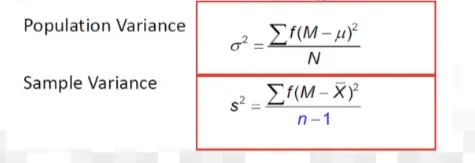
To use the population variance you need all of the data available whereas to use the sample variance you only need a proportion of it. For example, if we take ten words at random from this page to calculate the variance of their length, a sample variance would be needed.
- How many different samples can be created out of population of size n
The number of different samples of size n that can be selected from a finite population of size N is given by the combination formula, which is denoted as NCn. This formula is defined as NCn=N! n!
- What is the probability of drawing 2 jacks from a pack of card
The probability that the first will be a Jack is 4/52, or 1/13.
Without replacement, the probability that the second card will be a Jack given that the first is a Jack is 3/51, or 1/17.
Multiplying these two values
the probability that both draws will be Jacks. 1/13 x 1/17 = 1/221 ans.
- What is the probability that both the numbers on dice are same while rolling 2 dice
Sample points of getting same number on both dice
(1,1) ,(2,2) ,(3,3) ,(4,4) ,(5,5) & (6,6).
Hence, the probability of getting same number on both the dice is 1/6.
- Why standard deviation when variance can measure the dispersion in data
standard deviation is preferred over variance because standard deviation can be compared with the mean. The concept of variance has a central role in statistics because it is used to calculate other statistics like ANOVA, R-Squared, hypothesis testing, statistical inference, and more.