Basics of Probability and Statistics Week 1 Challenge
Q1- Why there is a difference in the formula of variance for population and sample?
Ans:- Population variance [σ*2 = 1/N ∑(x-n)*2], to calculate this we need all the data available where as for sample variance
[s*2 = 1/(N-1)*∑(x-n)4*2] only few portion of data is required. For example if we take ten words at random from this
page to calculate the variance of their length, a sample variance would be needed.
Q2- Difference between stratified and clustered sampling?
Ans- In Stratified sampling entire population is bifurcated into various mutually exclusive, homogeneous and non-overlapping
subgroups known as atrata.
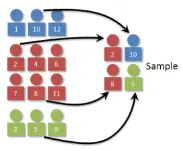
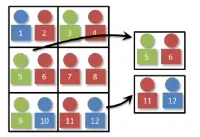
In clustered sampling the population is divided into already existing groupings known as clusters. The cluster refers to a
natural, but heterogeneous, intact grouping of members of the population.
Q3- How many different samples can be created out of population of size n ?
Ans- The size of the sample to be taken is equal to the size of the population. This means that the number of different random samples that can be taken is 1.
Q4- What is the probability of drawing 2 jacks from a pack of card ?
Ans- Probability of dwawing 2 jacks without replacement
for first jack- 4/52
for 2nd jack - 3/51
drawing two jacks = 4/52 * 3/51
= 12/2652
= 1/221
Q5- What is the probability that both the numbers on dice are same while rolling 2 dice ?
Ans- total sample = 36
outcome = 6
probability of same number on 2 dice = 6/36
= 1/6
Q6 - Why standard deviation when variance can measure the dispersion in data ?
Ans - The standard deviation is expressed in the same units as the mean is, whereas the variance is expressed in squared units.The Standard Deviation is a measure of how spread out numbers are where as the variance is the average of the squared differences from the Mean.