Basics of Probability and Statistics Week 1 Challenge
Q1.
In statistics, we take a sample of a population and say that the sample mean and sample variance are the same as the population mean and variance.
If we repeat this process many times by taking a different (but same sized) sample each time and averaged the results the result for the mean would indeed be close to the population mean. However, the sample variance would be underestimated (biased). If we multiply the variances by n/(n−1)n/(n−1) then the sample variances would also match the population variance.
The proof is a little beyond the scope of this answer and involves “degrees of freedom”. However, it can be demonstrated for a sample size of 1 where the sample mean would be xixi and the sample variance would be 00. This can’t be true unless every element in the population is the same. Unfortunately, scaling the sample variance would just mean that we get the meaningless 0000. That just means that we can’t find a variance with just a single sample (common sense).
Q2.
Difference Between Stratified and Cluster Sampling
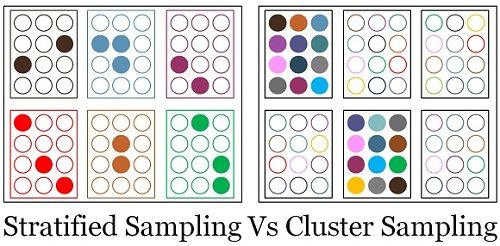 In our earlier article, we’ve discussed probability and non-probability sampling, in which we came across types of probability sampling, i.e. Stratified Sampling and Cluster Sampling. In stratified sampling technique, the sample is created out of the random selection of elements from all the strata while in the cluster sampling, all the units of the randomly selected clusters form a sample.
In stratified sampling, a two-step process is followed to divide the population into subgroups or strata. As opposed, in cluster sampling initially a partition of study objects is made into mutually exclusive and collectively exhaustive subgroups, known as a cluster. thereafter a random sample of the cluster is chosen, based on simple random sampling.
In this article excerpt, you can find all the differences between stratified and cluster sampling, so take a read.
Content: Stratified Sampling Vs Cluster Sampling
Comparison Chart
| BASIS FOR COMPARISON | STRATIFIED SAMPLING | CLUSTER SAMPLING |
|---|---|---|
| Meaning | Stratified sampling is one, in which the population is divided into homogeneous segments, and then the sample is randomly taken from the segments. | Cluster sampling refers to a sampling method wherein the members of the population are selected at random, from naturally occurring groups called 'cluster'. |
| Sample | Randomly selected individuals are taken from all the strata. | All the individuals are taken from randomly selected clusters. |
| Selection of population elements | Individually | Collectively |
| Homogeneity | Within group | Between groups |
| Heterogeneity | Between groups | Within group |
| Bifurcation | Imposed by the researcher | Naturally occurring groups |
| Objective | To increase precision and representation. | To reduce cost and improve efficiency. |
Q3. Ans:The size of the sample to be taken is equal to the size of the population. This means that the number of different random samples that can be taken is 1.
Q4.Ans: 2/52
1/26 (or) 0.038.
Q5. Ans: (1,1),(2,2),(3,3),(4,4),(5,5),(6,6)
=6/36
=1/6
Q6. Ans: The mean is the average of the range of given data values, a variance is used to measure how far the data values are dispersed from the mean, and the standard deviation is the used to calculate the amount of dispersion of the given data set values.