Assignment 4-RADIOSS Material Laws Challenge
OBJECTIVE:
To perform a simulation involving a solid spherical ball rupturing a shell plate. The shell plate is modeled with different materials and different failure modes. The following modifications are to be made:
- /FAIL/JOHNS card modified to crack plate
- Delete /FAIL/JOHNS card
- EPS_max deleted
- Law 2 johnson-cook changed to Law 1 elastic
PROCEDURE
CASE 1. Default parameters
- The starter file is imported using radioss solver_deck.
- The property card values are shown below
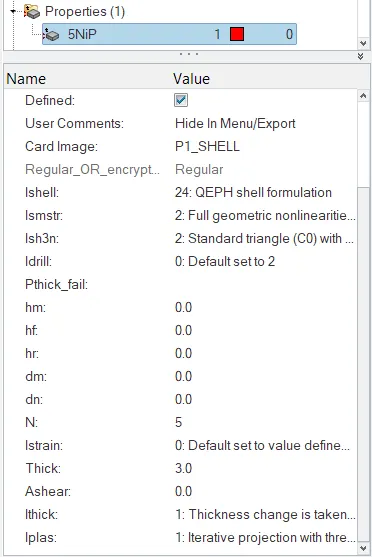
- The model is run with the RADIOSS solver and saved as Law2_epsmax_failure.
- Optionally the no of threads to be utilized can be specified using nt- 10
POST-PROCESSING
The anim file with the contour plotted along with the global variables are plotted on the Hypergraph 2D GUI
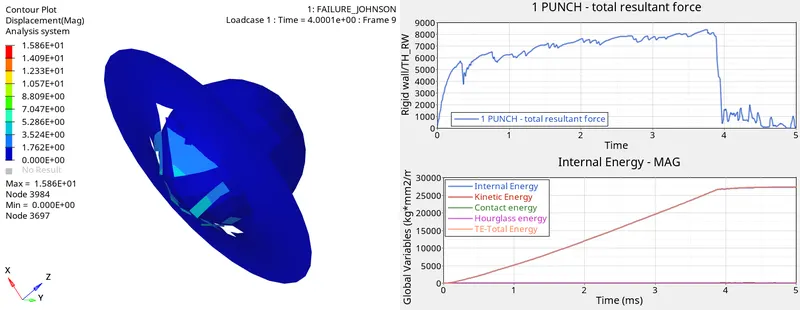
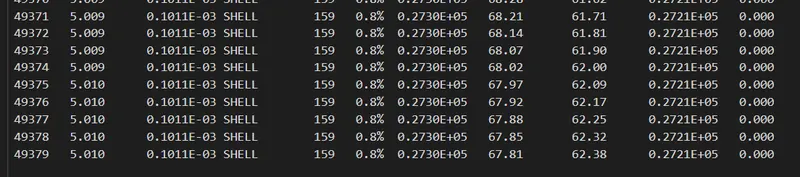
The energy error is 0.8% and is well within the allowed limit of 5% in the positive region. The mass error is observed to be 0
CASE 2:/FAIL/JOHNS card modified to crack plate
The following modifications are made to the fail card
-Ifail_sh =1 (Shell failure flag)
This means Shell is deleted or cracked when D=∑Δεpεf≥1">D=∑Δεpεf≥1D=∑Δεpεf≥1 for one integration point or layer. (default)
- Ifail_so is neglected because it is for solid failure
- Dadv = 1 for crack advancement (default)
- Ixfem = 1 with XFEM formulation
The model is run again using radioss solver with the file name as law2_epsmax_crack
POST-PROCESSING
The anim file with the contour plotted along with the global variables are plotted on the Hypergraph 2D GUI
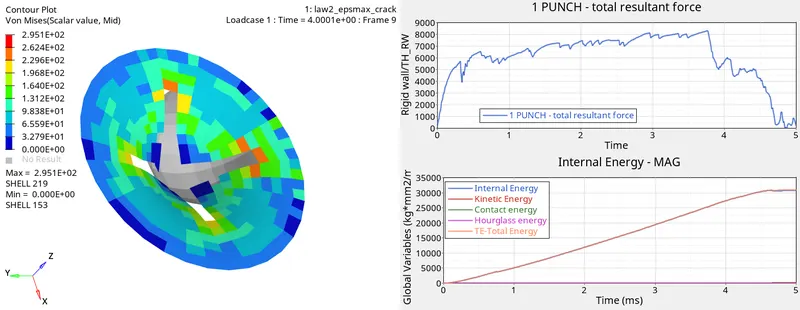
The energy and mass error is shown below
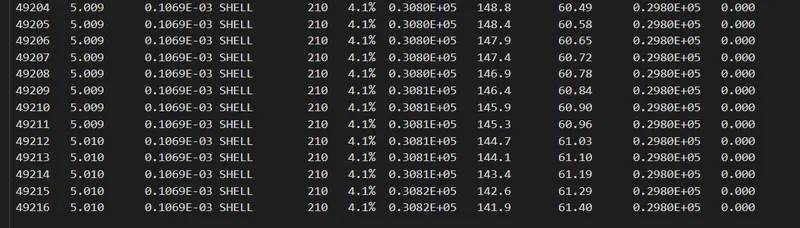
The energy error is high in this case however it is still within the acceptable limit (<5%).
CASE 3: Delete /FAIL/JOHNS card
The failure card is deleted. This implies the Johnson failure model is not applied during rupture.
POST-PROCESSING
The anim file with the contour plotted along with the global variables are plotted on the Hypergraph 2D GUI
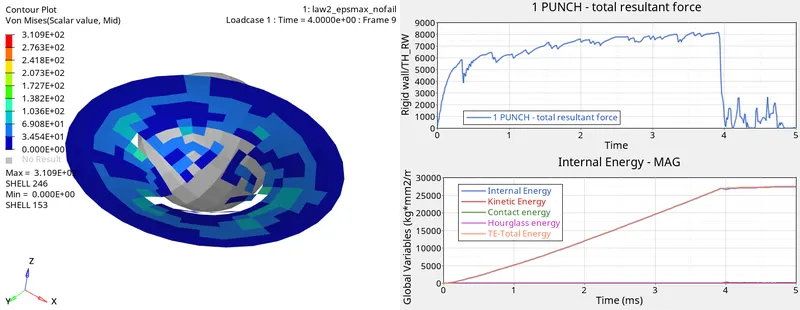
The energy and mass error is shown below
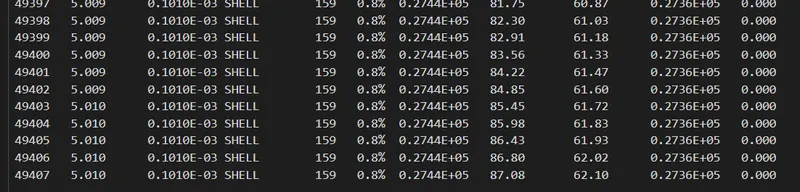
CASE 4: Delete Eps_max parameter
The Eps_max param which defines the plastic failure strain due to tension, compression, shear.
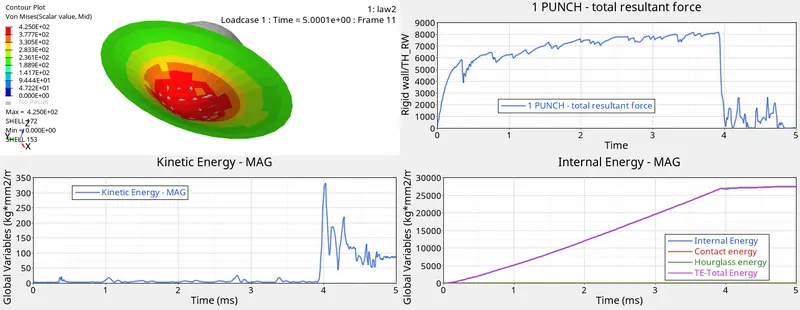
The energy and mass error is shown below

The energy error is high in this case however it is still within the acceptable limit (<5%).
CASE 5: Change mat to Law1
The Eps_max param which defines the plastic failure strain due to tension, compression, shear.
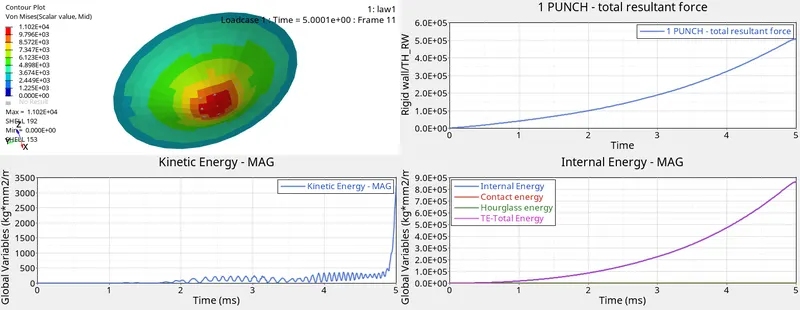
The energy and mass error is shown below
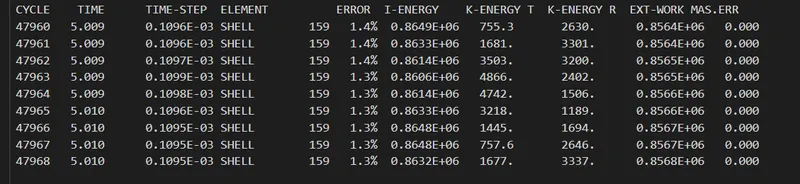
CASE 6: Change mat Plas_Brit
The material is changed to plast_brit (law 27). The eps_max param is not specified for this card because other failure parameters like Et,Em and Ef are specified.
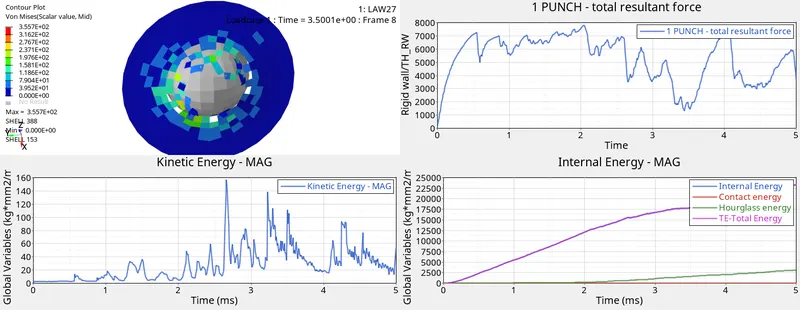
The energy and mass error is shown below

Unlike other cases the energy error is in the negative region however within the allowed limit of -15% to 0%
CASE 6: Change mat Plas_tab
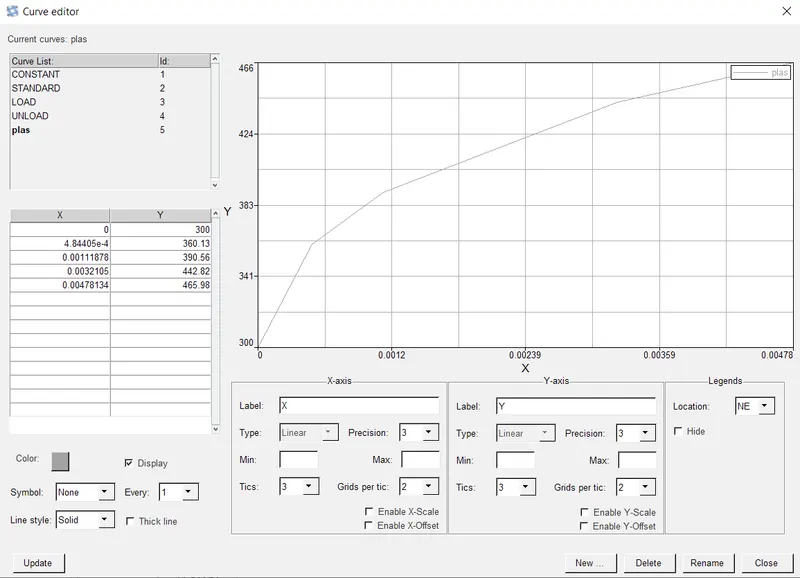
This law models an isotropic elasto-plastic material using user-defined functions for the work-hardening portion of the stress-strain curve (for example, stress vs. plastic strain) for different strain rates.
In this case, the johnson-cook failure model is used along with the plas_tab material. Hence the failure_johnson_0000.rad starter file is imported
most of the properties Poissons ratio, young's modulus, density are the same and the failure parameters are modified and the stress-strain curve for the plastic material is tabulated on a new user-defined curve (as shown below)
POST-PROCESSING
The anim file with the contour plotted along with the global variables are plotted on the Hypergraph 2D GUI
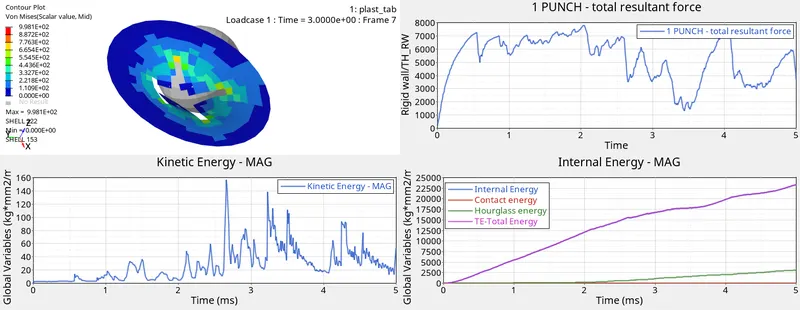
The energy and mass error are shown below
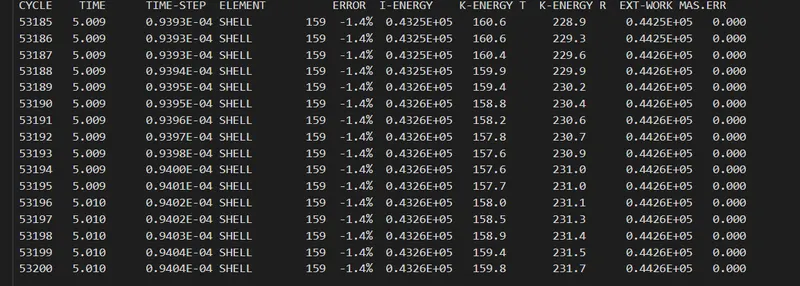
CONCLUSION
COMPARISON
The different results for the first 5 cases are shown below
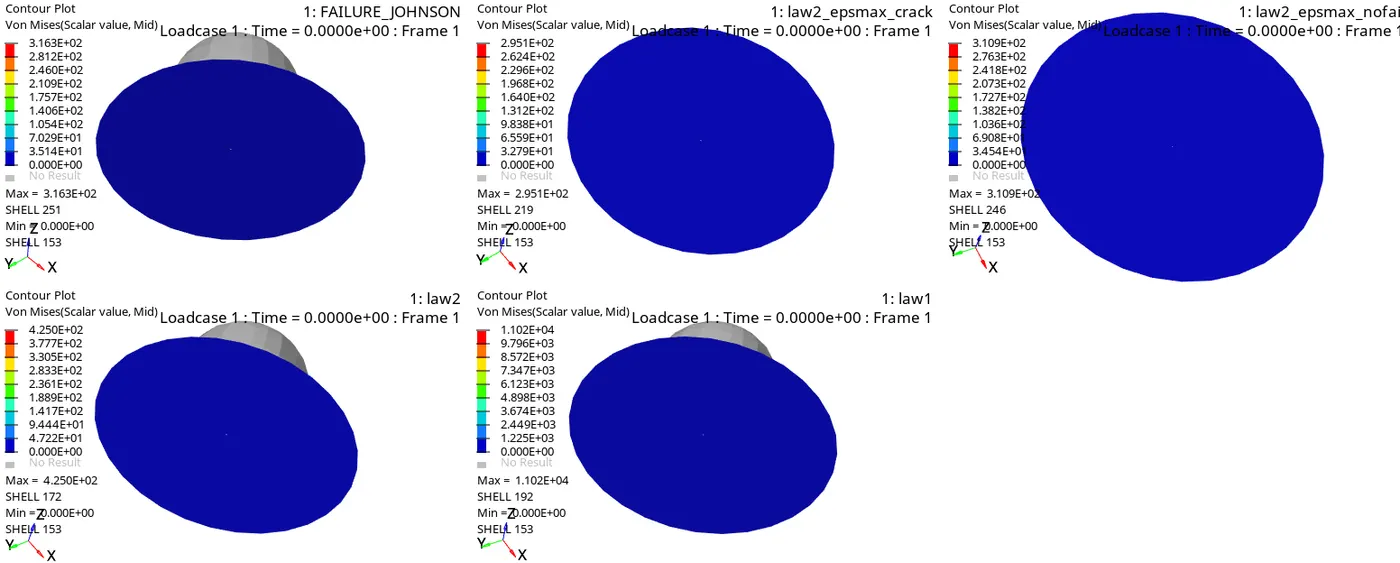
-It is evident that the rupture of the shell plate change is drastic once the eps_max value is deleted. The eps_max value cause failure for the corresponding element once it reaches the specified plastic strain. The element gets deleted from the system once it reaches Ef specified value.
-From the first 3 cases, case 2 has the least stress developed because crack propagation is allowed hence this reduces the resistance or stiff offered by the plate in case1.
-Due to change in failure method, the stress generated in the shell varies.
- For the first 5 cases there is no hourglass energy generated.
- The kinematic energy is negligible compared to the internal energy generated in the model.
-There is a hourglass energy generated in the plas_brit and plas_tab material model.
-The plas_tab and plas_brit materials have same rigid wall and global energy reaction however the stress magnitude varies significantly
-The rigidwall forces for the case2 implies that due to crack propagation rather than direct element deletion with high stress, the rigidwall forces after impact and rupture declines gradually without a sudden drop like in other cases.