Assignment 4-RADIOSS Material Laws Challenge
Objective:
To study the different material law’s in RADIOSS. The following material Law’s are considered and compared for energy error, crack, mass error, simulation time, energy differences, total number of cycles and simulation time.
Laws considered:
- Law2_epsmax_failure
- Law2_epsmax_crack
- Law2_epsmax_nofail
- Law2_noepxmax_nofail
- Law1 – elastic material
- Law36 – tabulated elastoplastic material
- Law27 – elastoplastic brittle material
Law 1(Elastic material)
This law defines the isotropic, linear elastic material which is modelled using hooks law. This law models the relationship between the stress and strain and is available for truss, beam, shell, and solid elements. This law is usually used when attached rigid body is used. This law is used to model purely elastic materials.
Law2 (PLAS_JHONS)
This law represents n isotropic elasto-plastic material using the Johnson-cook material model. This is used to express the stress as a function of strain rate, strain, and temperature. A built-in function is used to define the failure criterion on the max. plastic train available.
Law 36(PLAS_TAB)
This law is used to model using user defined function of a stress – strain curve for an isotropic elasto-plastic material for different strain rates. This law is available for brick and shell elements and uses linear interpolation of strain- stress curve. In order to avoid the poor curve extrapolation during the calculation of the strain, a dummy curve for a higher strain rate is defined in the model.
Law 27(PLAS_BRIT)
This law combines an isotropic elasto-plastic Johnson-cook material model with an orthotropic brittle failure model. Material damage is accounted for prior to failure. Failure and damage occur only in tension and is applicable only for shells.
Procedure:
Case 1 - Law2_epsmax_failure.
The material is defined with Johnson failure model and an epsmax failure. When the material reaches the epsmax value it would delete cells and shows the breakage.
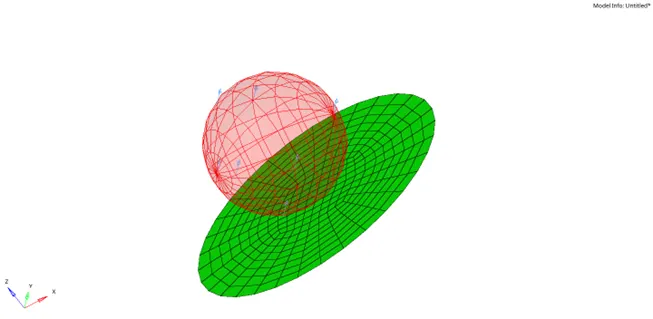
Step1: Import the failure_johnson_0000.rad
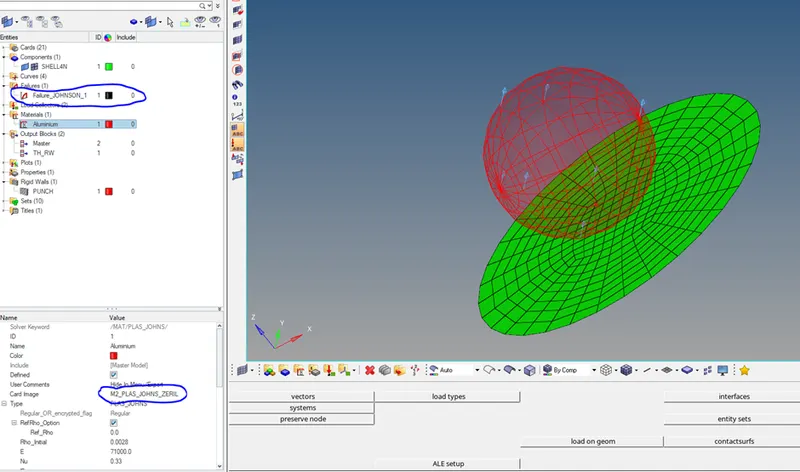
Step2: Define M2_plas and failure Jonson
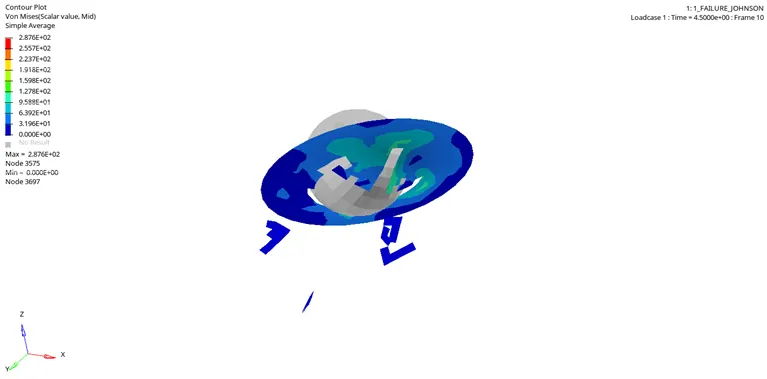
Step 3: Run the RADIOSS solver and save it as LAW2_epsmax_failure and open it in HyperView, to check for the failure using Von misses stress.
Step 5: Similarly for other material laws the corresponding material changes are made and checked for failure
Case2 - Law 2_ epsmax_crack:
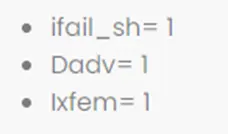
The following changes are made in the failure Johnson
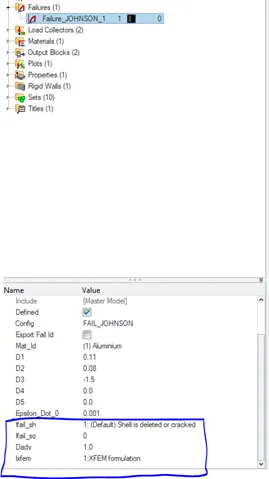
Case3 – Law2_epsmax_nofail.
The Johnson failure card is removed/ deleted and the simulation is performed.
Case4 – Law2_noepsmax_nofail
Both the Johnson failure card and the epsmax are removed.
Case 5 – Law1.
The material card is changed to Law 1 with the same E, Rho, and Nu values.
Case 6 – Law 36 (Plast_tab)
For this material card, a stress-strain curve is defined with the same E, Rho, and Nu values. The following values are used for the material card.
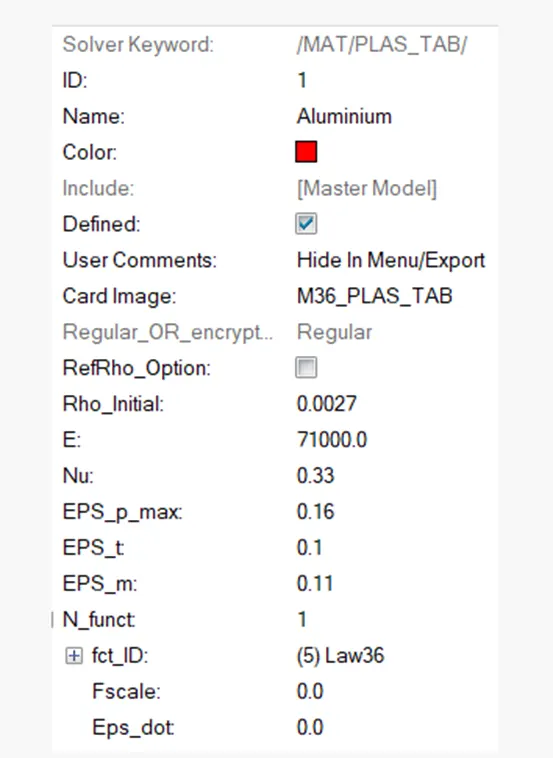
The curve is defined as follow
- Right click on the curve and create a new curve.
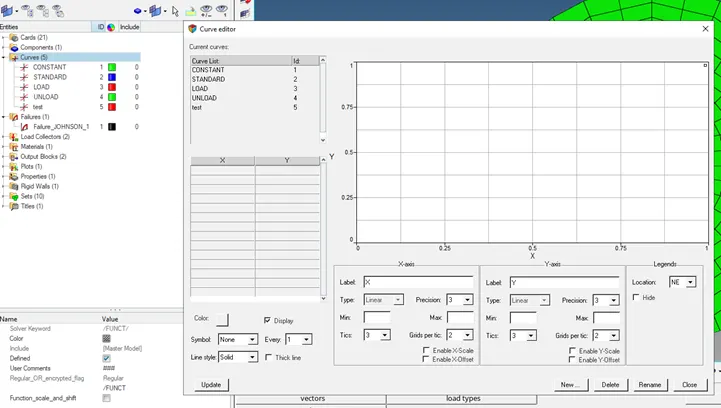
- The following values are assigned for the curve
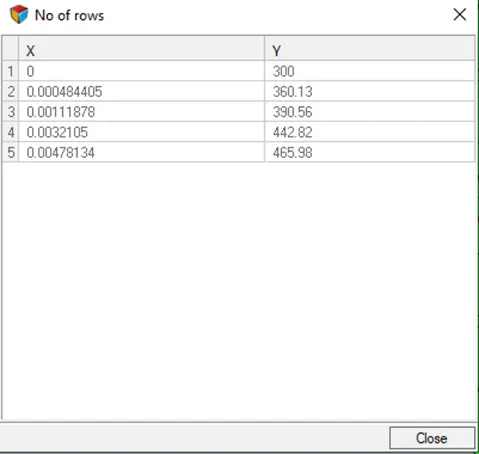
- The curve is then defined to the material card using the function option.
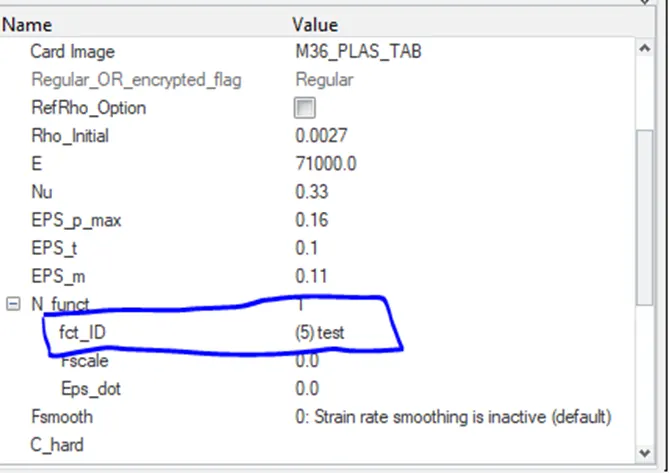
Case 7- Law 27.
The law27_0000.rad is imported and the law 27 is selected with appropriate shell properties and material values.
Result discussion
Comparison of the energy error, mass error, total no. of cycles and simulation time.
|
Material Law |
Total no. of cycles |
Energy error (%) |
Mass error |
Simulation time (s) |
|
Failure_johnson |
49480 |
0.2 |
0 |
959.68 |
|
Law2_epsmax_failure |
49397 |
4 |
0 |
1176.82 |
|
Law2_epsmax_crack |
49405 |
0.8 |
0 |
1074.15 |
|
Law2_noepsmax_nofail |
48737 |
3 |
0 |
1113.74 |
|
Law 1 |
47969 |
0.3 |
0 |
902.60 |
|
Law 36_elstoplastic tab |
53181 |
-1.2 |
0 |
996.75 |
|
Law 27 |
49356 |
1 |
0 |
1130.31 |
Except for Law 36, there is energy creation for other material cards. An error of 1% or 2% is acceptable and greater energy error percentage is caused due to incompatible kinetic energy and its source to be identified, which is the case for law2_epsmax_failure and law2_noepsmax_nofail. Comparing the results, the best material card for aluminium (selected material) Law 1 would be the appropriate material card as the simulation time is less and is specially used for truss, beam, solid and shell elements. Even though the energy error is positive it is in the acceptable range. The mass error is zero in all the cases.
Comparison of failure of the different material law
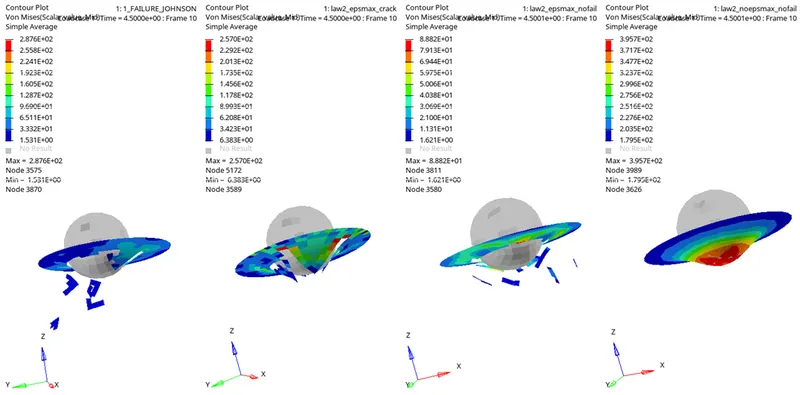
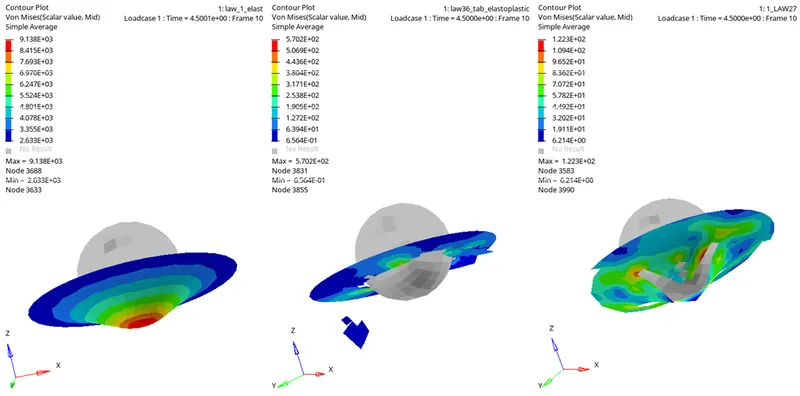
Except for the case 5 and 4, all other material law, deletes the cell on the max. stress value is attained. Also, as discussed in the table law 1 shows the maximum stress for the model, which is once again confirmed through the von misses stress analysis.
Comparison of the energy graphs
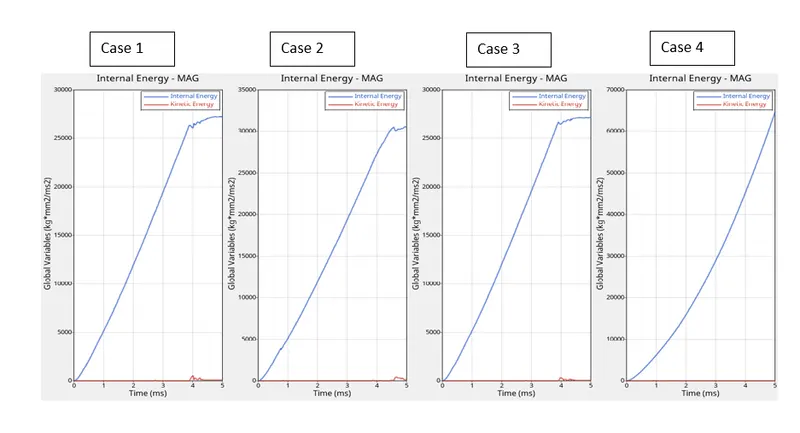
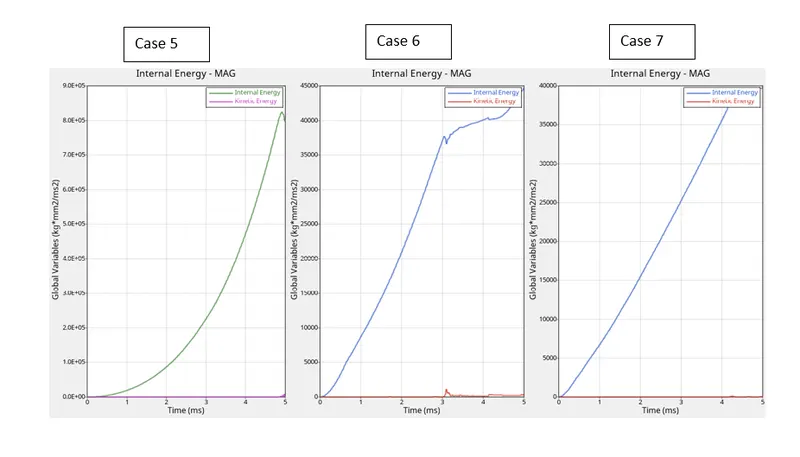
From the plots we could see that case 5 as discussed before shows the maximum stress failure value. Since the failure card is not defined, we obtain a smooth curve for case 4 and 5. further, we could see that the Nternal energy and KE are same for all the material card. This helps us to conclude that Law 1 is the appropriate materialcard for the defined material.