FAILURE BEHAVIOR STUDY FOR A DROP TEST USING DIFFERENT MATERIAL MODELS USING RADIOSS
AIM: To study the failure behavior of a punch and plate model(DROP TEST) using different material models.
ABSTRACT: In this report, I have made a study on the failure behavior of a plate impacted by a punch based on different material model cases. The following cases are to be analyzed so as to make a final comparison.
7 different cases:
- Simulation with both failure plastic strain (Eps_P_max) & Johnson failure card Enabled.
- Simulation with both failure plastic strain (Eps_P_max) & Johnson failure card Enabled.(with Ishell_sh=1, Dadv=1, Ixfem= 1).
- Simulation after removing fail_ Johnson failure card.
- Simulation after failure plastic strain (Eps_P_max) value removed.
- Simulation after changing the material law to LAW1(ELASTIC). (keeping rho, e, nu values same)
- Simulation with the material model as LAW27.(keeping the properties as recommended).
- Simulation of the model by changing the material law as LAW36 (PLAS_TAB).
INTRODUCTION:
There is a Big library available with Radioss as shown below:
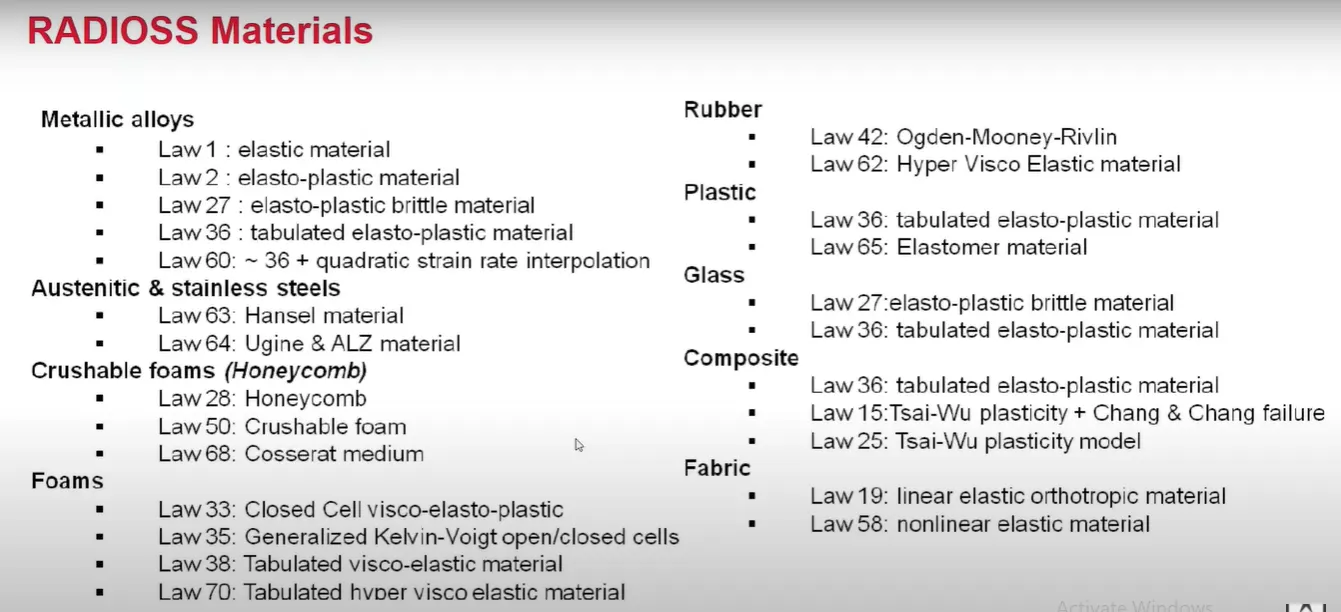
Before any good simulation, a user should have a proper input to the material values.
The Material may be Categorized as,
- Isotropic Elasticity
- Isotropic Elastic-plastic
- Composite and Anisotropic
- Viscous
- Hydrodynamic
- Explosive
Punch and Plate model (DROP TEST)
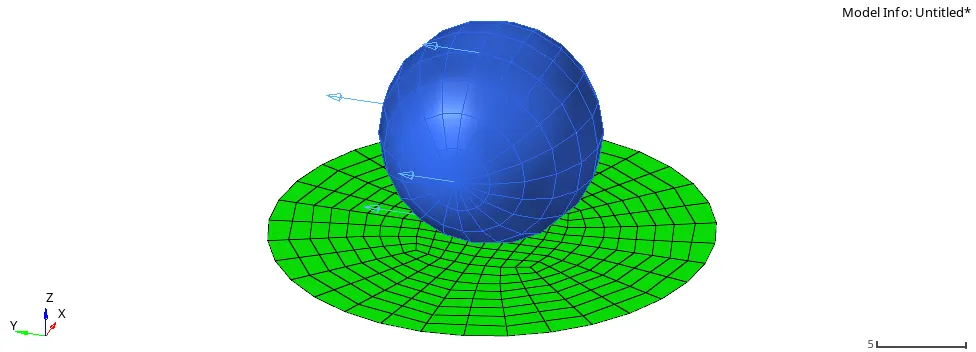
Key parameter used :
Johnson_Cook parameter
SIGY- This indicates the yield strength
b, n- Hardening modulus and hardening exponent help in determining how well the curve will bend and how quickly the curve will bend.
Eps_P_max -Plastic strain at failure(point of rupture). eg. 0.4 means fails at 40 % of plastic strain. Failure happens when anyone integration point reaches Eps_p_max value
Failure Johnson model
Ixfem- This help us to decide how do we want to fail this particular material.
- '0' value defines that deletes the whole element.
- '1' value will try to break the element the way it should have cracked.
Dadv- Criterion for crack advancement (only activates if Ixfem =1)
D1, D2, D3- This determines what is the strain or what mode of strain is needed for an element to break.
PROCEDURES:
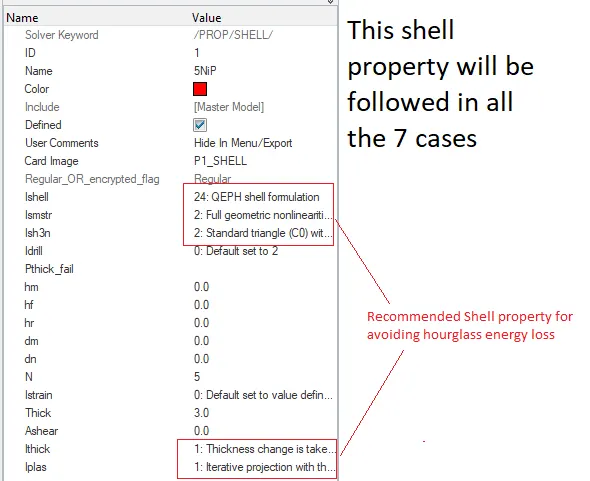
Case1:
Simulation with both failure plastic strain (Eps_P_max) & Johnson failure card Enabled
We need to make sure the shell properties are set as per recommended then import the run file.
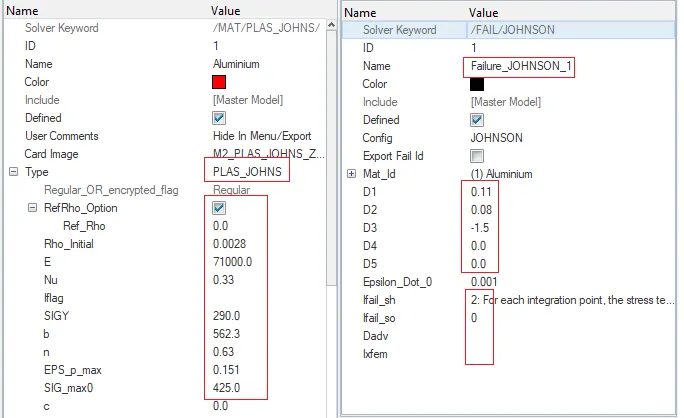
The material and failure card properties are set as shown above for case 1.
Run the radioss file and save the file with Law2_epsmax_failure_0000.rad name for case 1.
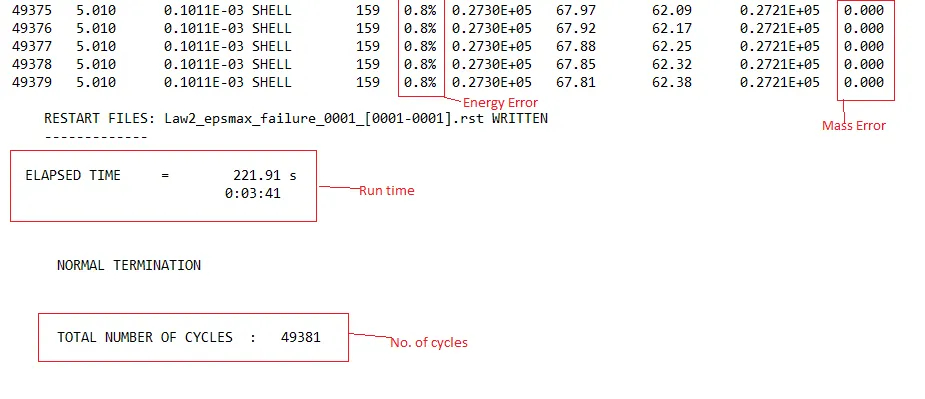
Energy error is 0.8 % and mass error is zero so it is within the acceptable range. Also, the run time is 3min 41 sec with Total No. of cycles 49381
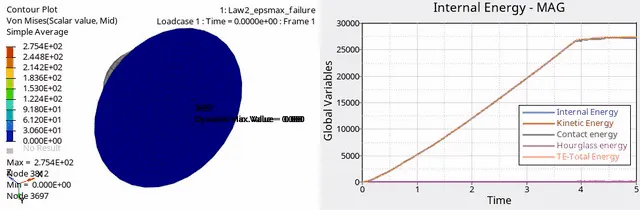
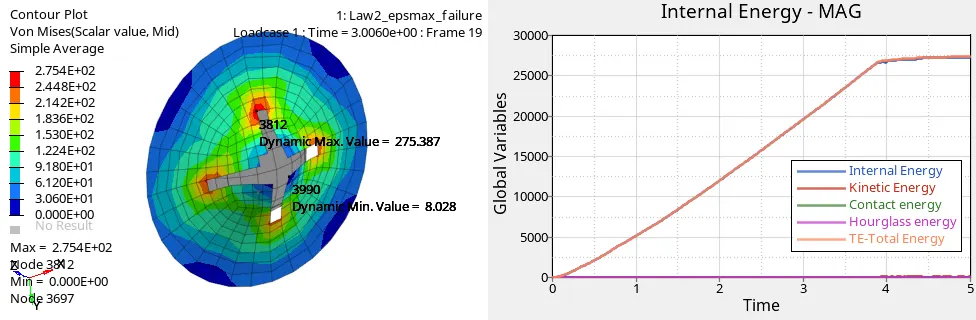
It is very much visible that the failure happens with element deletion rather than crack propagation as the ixfem value and Dadv value both corresponds to zero. This case has both failure cards as well as Eps_P_max value(0.151) so the D1, D2, D3 values determine the mode strain is needed for an element to break. The max value of von-mises stress is 275.4 Gpa. at node 3812. (as shown below) with kinetic energy rising from 0 at t=0 to a value of 27500 at ~4 ms and remain constant after contact. The positive Energy Error of 0.8 % indicated that energy is created as we are using QEPH shell elements to avoid hourglass energy. (If the value is above 5 % then the source of energy should be identified)
Case2:
Simulation with both failure plastic strain (Eps_P_max) & Johnson failure card Enabled(with Ishell_sh=1, Dadv=1, Ixfem= 1)
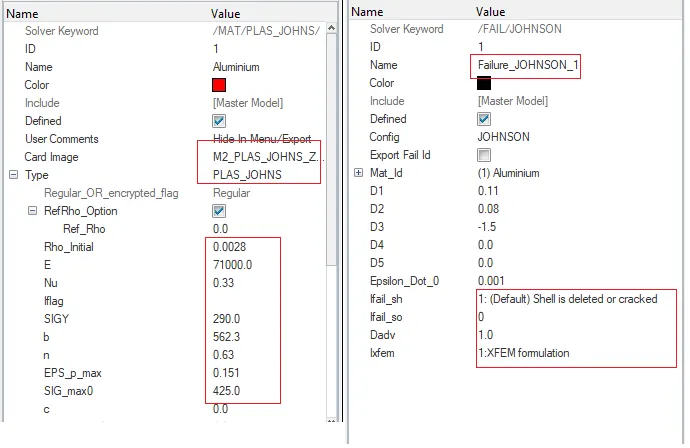
The material and failure card properties are set as shown above for case 2.(Ifail_sh=1, Dadv=1, Ixfem=1)
Run the radioss file and save the file with Law2_epsmax_crack_0000.rad name for case 2.
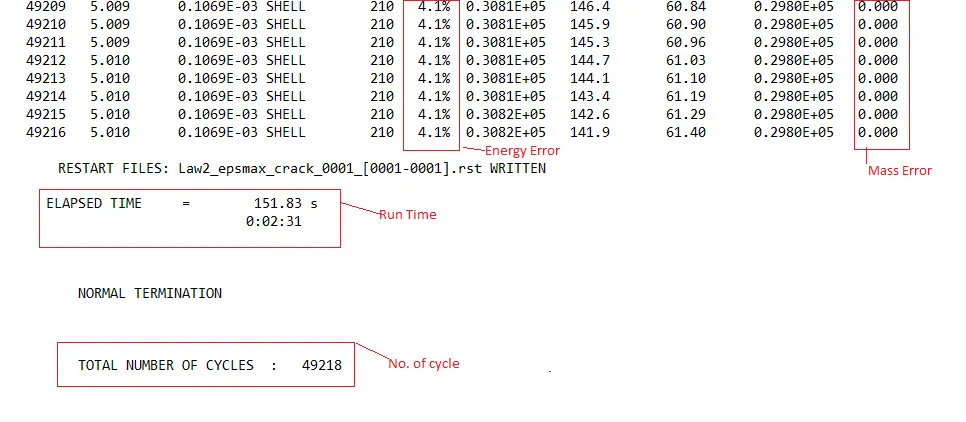
Energy error is 4.1% and mass error is zero so it is within the acceptable range. Also, the run time is 2min 31 sec with Total No. of cycles 49218
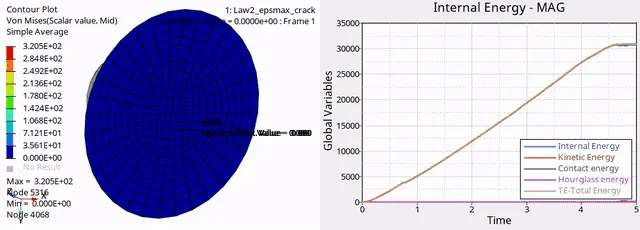
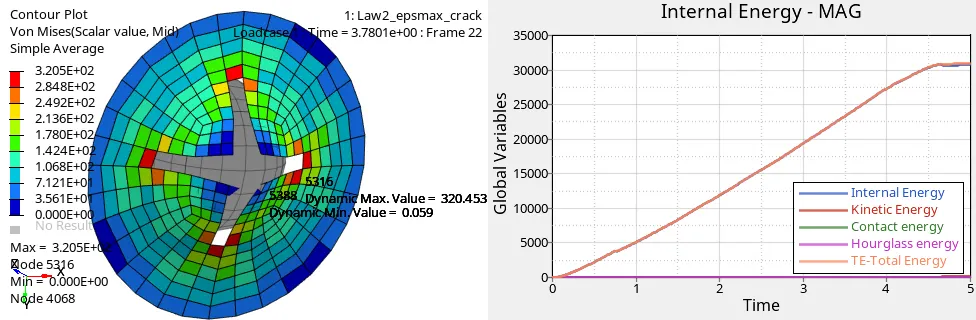
In this case inside the material card Ifail_sh=1, Dadv=1, Ixfem=1 are setup where Dadv is the criterion for crack advancement(only activates with ixfem value =1). in the animation, it is clearly visible that the crack propagates, failure happens and then element gets deleted. The maximum value of Von-mises stress is 320.5Mpa at node 5316. Also, the kinetic energy rising from 0 at t=0 to a value of 32000 at ~4.7 ms and remain constant until the end of the simulation. The positive Energy Error of 4.1 % indicated that energy is created as we are using QEPH shell elements to avoid hourglass energy. (If the value is above 5 % then the source of energy should be identified)
Case3:
Simulation after removing fail_ Johnson failure card
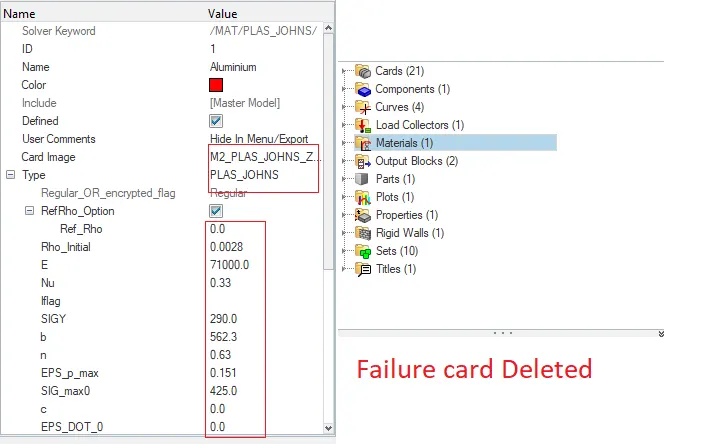
The material properties are set as shown above for case 3 and the failure card should be removed.
Run the radioss file and save the file with Law2_epsmax_nofail_0000.rad name for case 3.
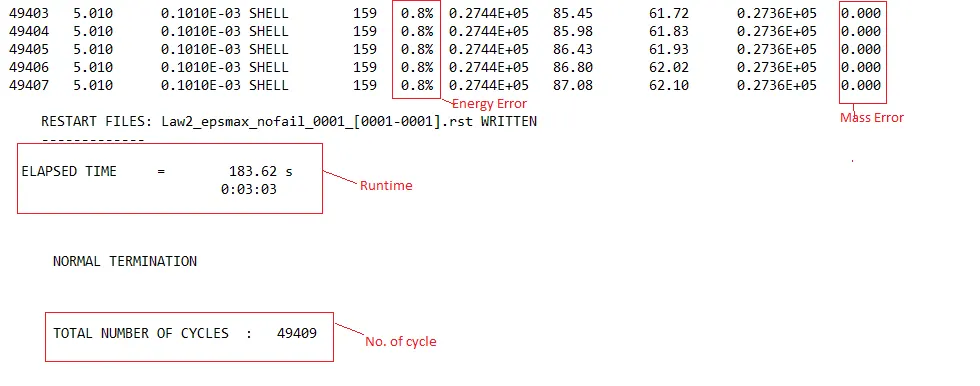
Energy error is 0.8 % and mass error is zero so it is within the acceptable range. Also, the run time is 3min 3 sec with Total No. of cycles 49409
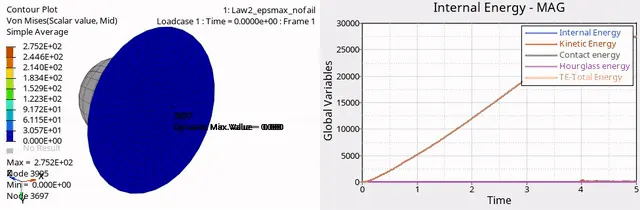
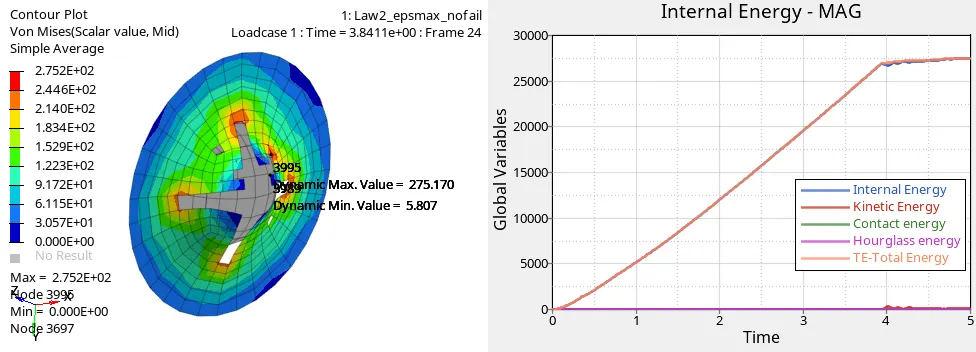
In this case, the failure card is deleted therefore the failure will occur as per the Eps_p_max value which is 0.151 i.e. 15.1 % of plastic strain value. Also, there will be no crack propagation before any element deletion as no failure card. The max von misses stress will be 275.2 Mpa at node 3995(as shown below). The kinetic energy rising from 0 at t=0 to a value of 27500 at ~4 ms and remain constant until the end of the simulation. The positive Energy Error of 0.8 % indicated that energy is created as we are using QEPH shell elements to avoid hourglass energy. (If the value is above 5 % then the source of energy should be identified)
Case4:
Simulation after failure plastic strain (Eps_P_max) value removed.
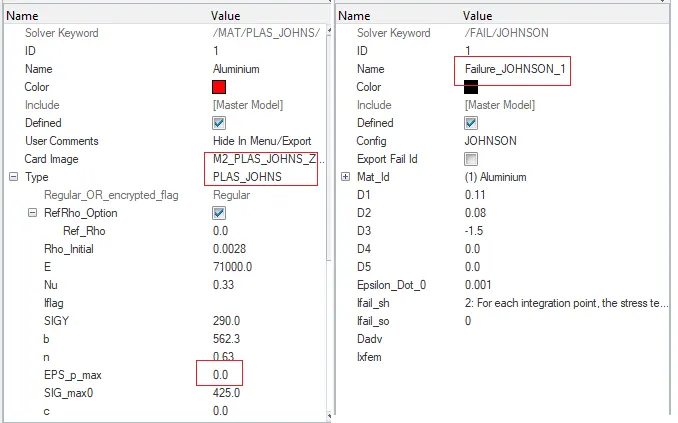
The material and failure card properties are set as shown above for case 4.(Eps_p_max= 0)
Run the radioss file and save the file with Law2_0000.rad name for case 4.
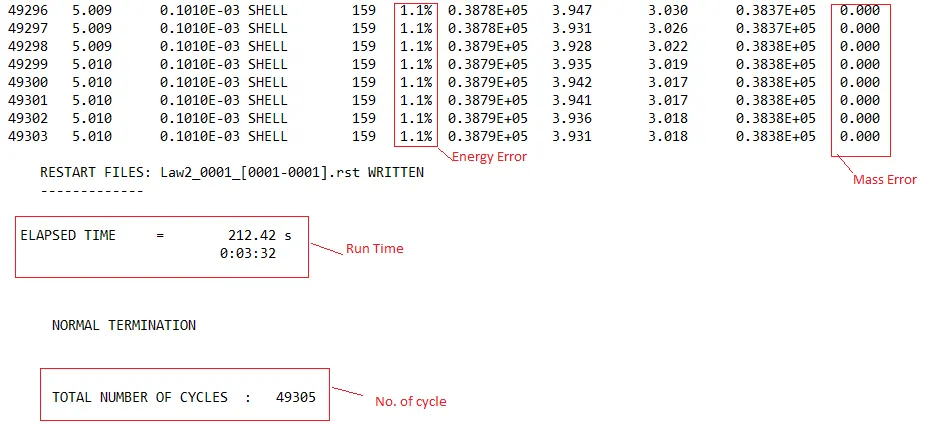
Energy error is 1.1 % and mass error is zero so it is within the acceptable range. Also, the run time is 3min 32 sec with Total No. of cycles 49305.
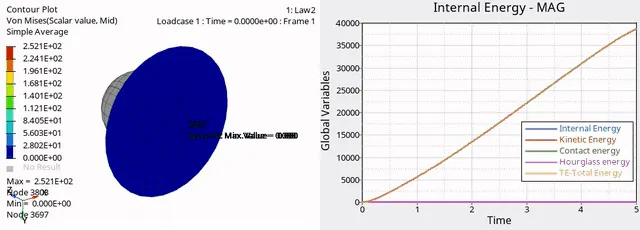
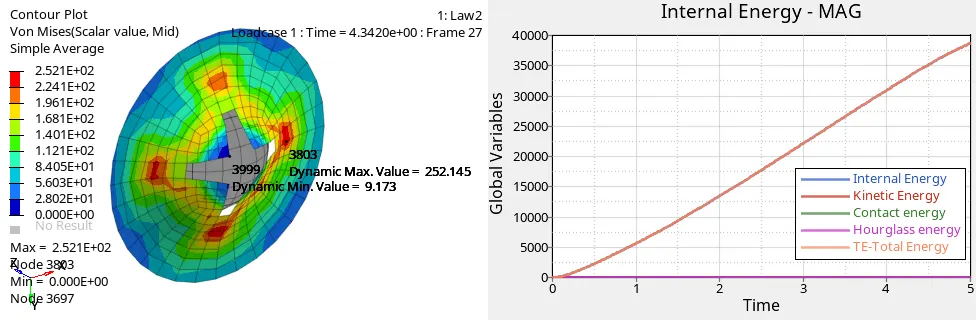
In this case, we have set the value of plastic strain max value to zero with a failure card which will show a crack propagation but there will no failure as the value of Eps_max is 0 therefore we can see no deletion of elements during the simulation. Also, we can see that the energy Vs time the kinetic energy increases throughout the simulation with highest value as nearly 40000 at the simulation end. The value of max Von-mises stress is 252.1Mpa at the node 3803. The positive Energy Error of 1.1 % indicated that energy is created as we are using QEPH shell elements to avoid hourglass energy. (If the value is above 5 % then the source of energy should be identified)
Case5:
Simulation after changing the material law to LAW1(ELASTIC)(keeping rho, e, nu values same)
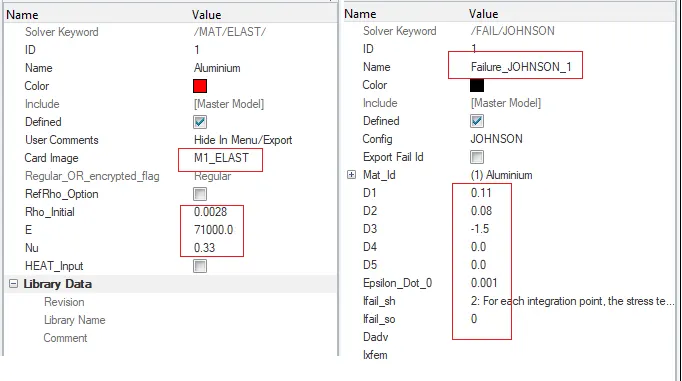
The material(M1_ELAST) and failure card properties are set as shown above for case 5.(Elastic material -Law1)
Run the radioss file and save the file with Law1_0000.rad name for case 5.
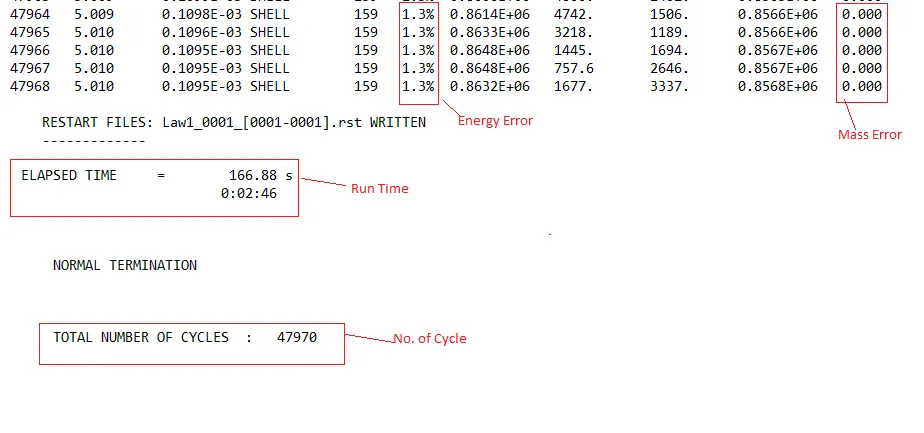
Energy error is 1.3 % and mass error is zero so it is within the acceptable range. Also, the run time is 2 min 46 sec with Total No. of cycles 47970
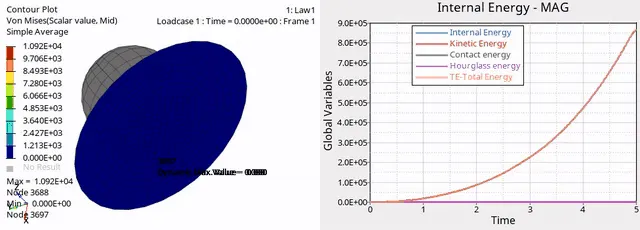
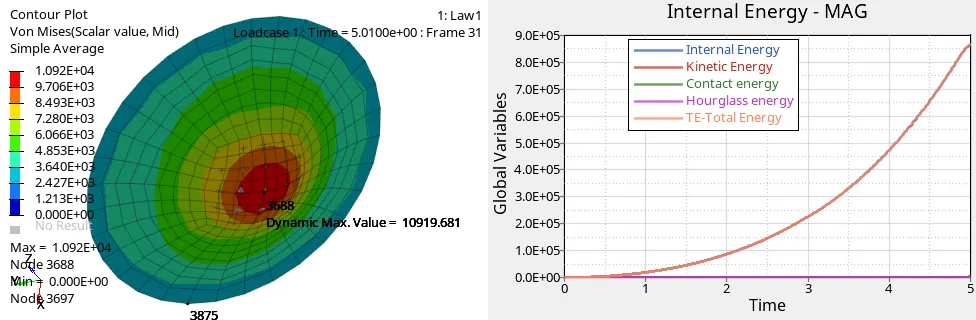
In this case, the material type is changed from M2 PLAS_JOHN to LAW1 M1_ELAST with the same value for rho, E, and nu. The plate undergoes an elastic deformation throughout the simulation. The max von-mises stress generated is much higher as the elastic material undergoes very high deformation i.e. very high internal energy over the simulation time. The maximum von-mises stress value is 10920 Mpa at node 3688. The positive Energy Error of 1.3 % indicated that energy is created as we are using QEPH shell elements to avoid hourglass energy. (If the value is above 5 % then the source of energy should be identified)
Case6:
Simulation with the material model as LAW27.(keeping the properties as recommended)
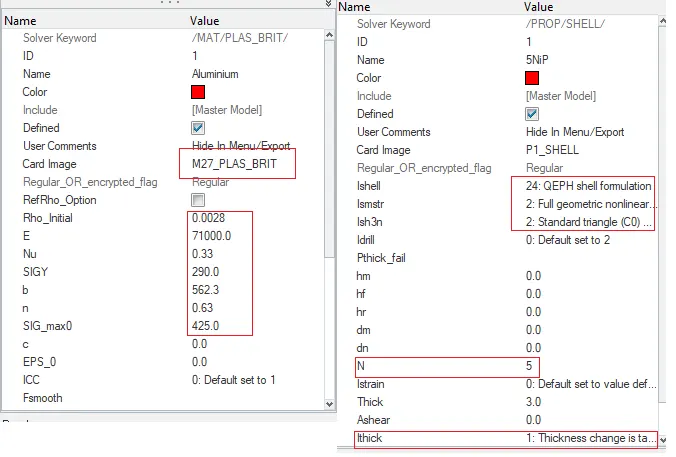
The material(M27-PLAS_BRIT) and failure card properties are set as shown above for case 6.(M27 Plastic_Brittle).
Run the radioss file and save the file with Law27_0000.rad name for case 6.
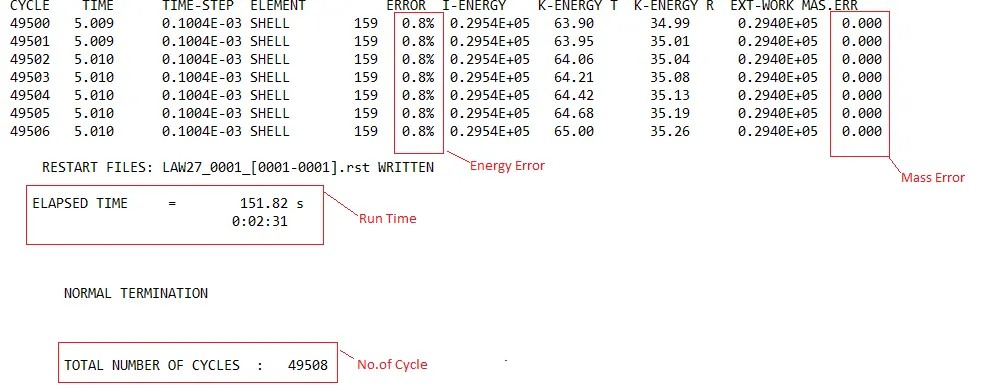
Energy error is 0.8 % and mass error is zero so it is within the acceptable range. Also, the run time is 2min 31 sec with Total No. of cycles 49508.
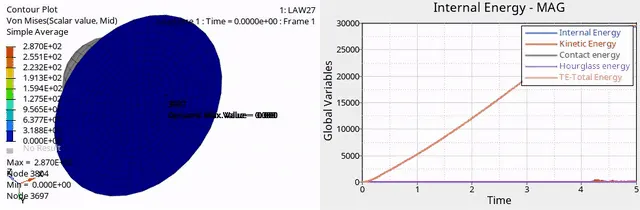
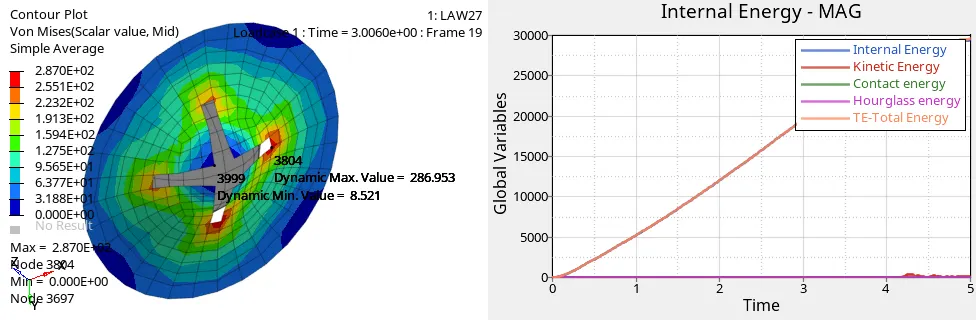
In this case the material type changes to LAW27/M27_PLAS_BRIT this is mainly used for brittle material. This can only be used for shell elements. Material damage is accounted for much prior to failure following orthotopic brittle failure mode. The Von-mises max value is 287 Mpa at node 3804. As the material shows the brittle nature the fracture appears over the center of the plate. The positive Energy Error of 0.8 % indicated that energy is created as we are using QEPH shell elements to avoid hourglass energy. (If the value is above 5 % then the source of energy should be identified)
Case7:
Simulation of the model by changing the material law as LAW36 (PLAS_TAB)
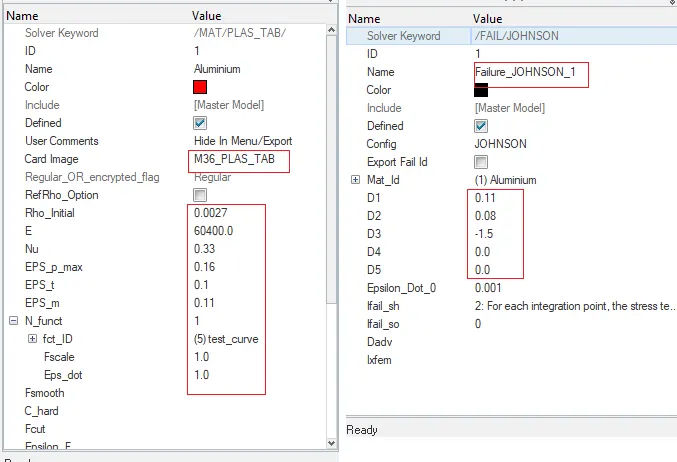
The material(M36_PLAS_TAB) and failure card properties are set as shown above for case 7.
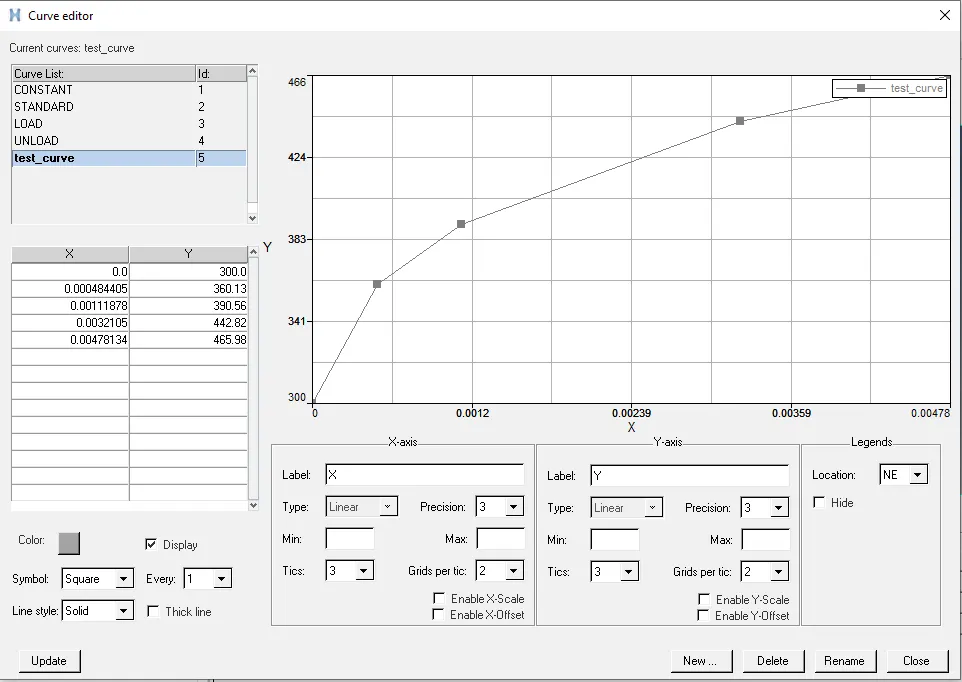
Also, build the test curve with lab data's as input for fct_ID (as shown below).
Run the radioss file and save the file with Law36_0000.rad name for case 7.
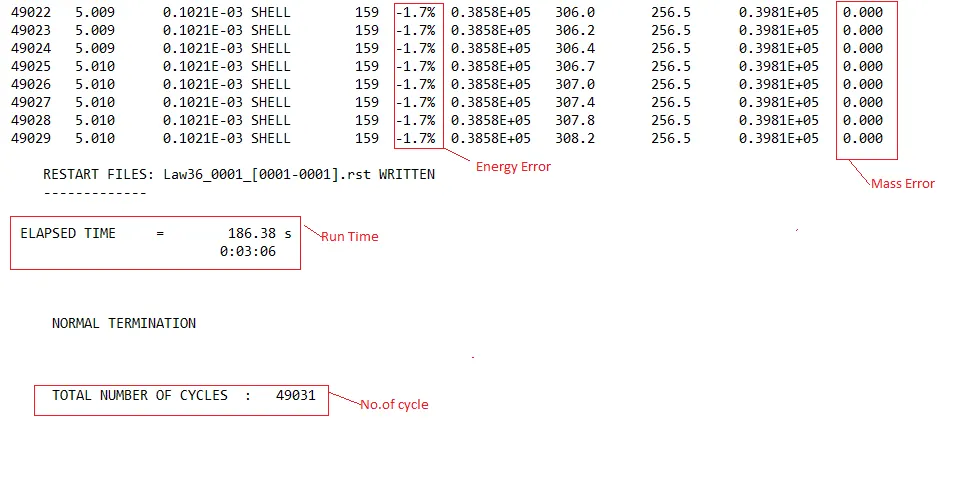
Energy error is -1.7% and mass error is zero so it is within the acceptable range. Also, the run time is 3min 06 sec with Total No. of cycles 49031.
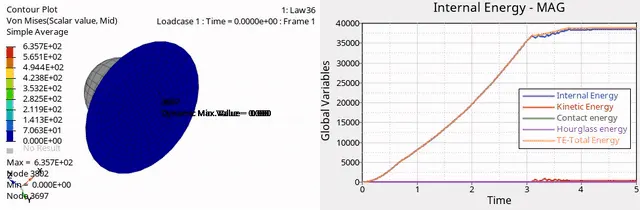
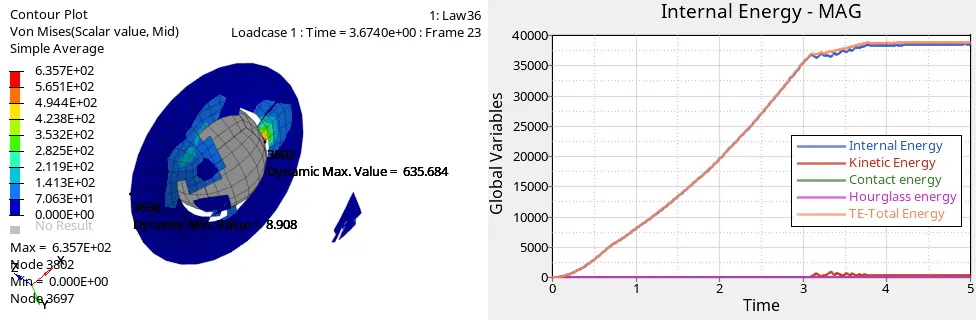
In this case, we change the material type as LAW36 or M36_PLAS_TAB with a test curve with data as a user-defined function for the work hardening portion of the stress-strain curve for different strain rates. As we can see that a row of an element after the impact gets deleted due to increased strain locally. The value for the energy Error is -1.7% which indicated energy dissipation. Although the hourglass energy and contact energy are zero throughout the simulation. The max value of von Mises stress is equal to 625.7Mpa at node 3802 which is higher than the ultimate stress of Aluminum. Also, the K.E increases to reaches 37500 value at nearly 3 ms then remains constant after that till the end of the simulation.
COMPARISON TABLE :
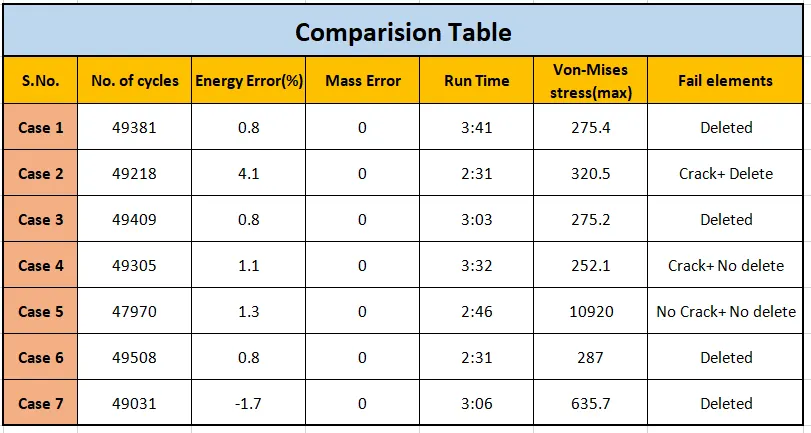
CONCLUSION
It is the user who has to define the material property which represents the best for better simulation results. After looking at all the cases we can conclude that M36_PLAS_TAB /LAW36 represents the most real-life industrial scenario where the experimental or Lab data can be used in the simulation which is case 7. Other than that case 2 with M2_PLAS_JOHN/LAW2 material card and failure johnson model card demonstrate very relevant information about the failure of the plate(crake and delete). The LAW 27 /M27_PLAS_BRITT is mostly used for brittle material(glass).