Assignment 3-2D Element Formulation Challenge
Objective:
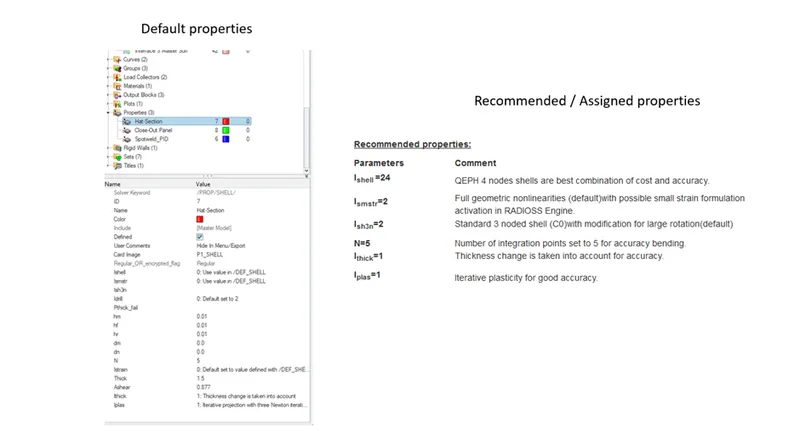
To compare the material card properties with the default values and the recommended (Assigned) properties.
Procedure:
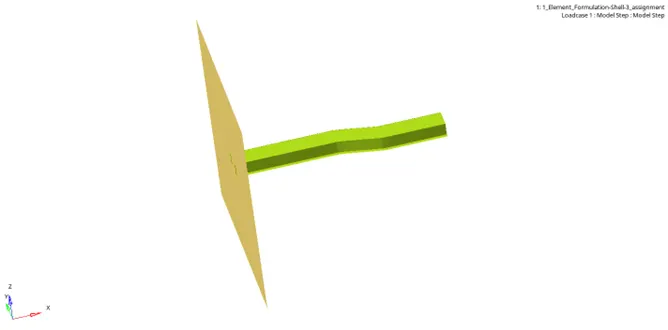
A simple beam element is assumed for the study with a run time of 55ms and tfreq = 1s. The model used for the study is depicted below, captured using Hypergraph.
The simulation is carried out using Radioss with default properties and Assigned properties. Different parameters are studied to understand the importance of selecting the appropriate property card for the element formulation. The following are the parameters which would be discussed in the study performed:
Energy error, Mass addition/ mass error; Displacement; Hourglass; Von mises stress; Resultant forces and the global variable.
Energy error and Mass error: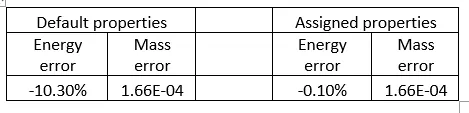
The above table shows the error and mass error from both the simulations. The energy error is negative in both the case which confirms that energy is been dissipated. Comparing the default properties, the assigned properties results are in accordance with the suggested value, which states that closer to 05 the better the error and ideally to stay between -15% to -5%. Comparing both the values, the assigned properties have a better numerical solution. The change in error percentage is due to the application of QEPH element formulation which has a better hourglass stabilization with improved 4-noded element formulation. In case of Mass error both the properties produce same error.
Global Variables and Resultant forces:
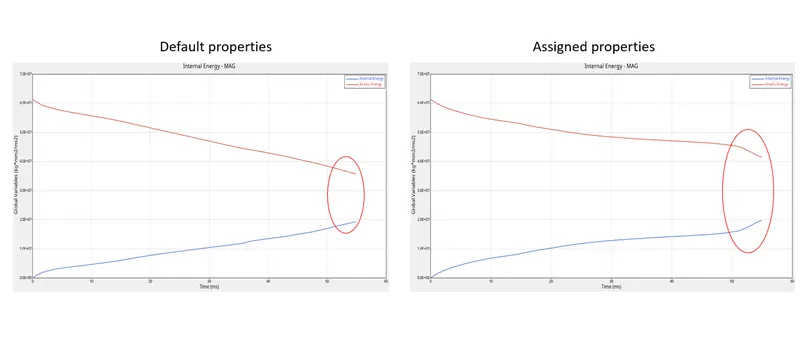
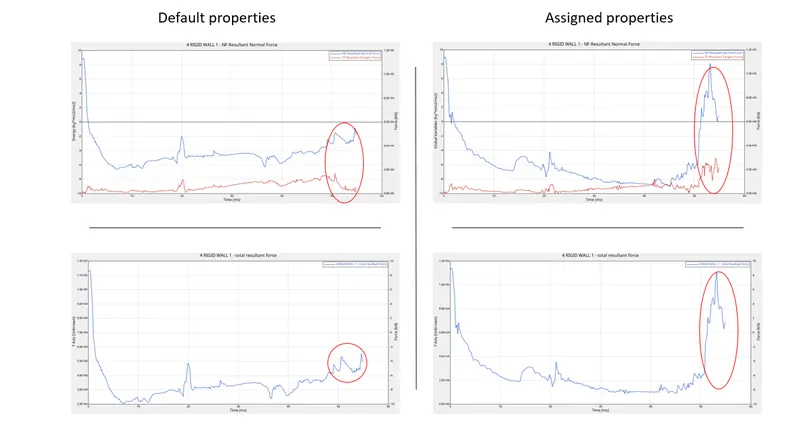
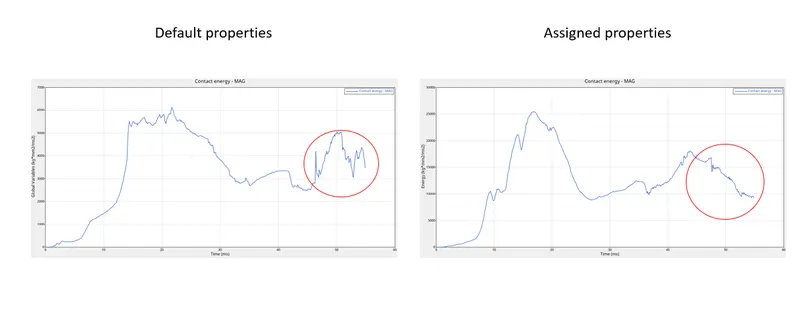
The recommended properties have a better hourglass stabilization and improved 1 integration point. This helps in solving with better compromise between cost and quality, when compared to fully integrated element formulation which has higher CPU cost. The plots highlight (red circled) the solution quality, when compared to the default properties. The normal and resultant forces better solved, showing the energy dissipation in the plots shown below. The dissipation of the total and the normal forces are higher and is captured appropriately using the assigned properties. Whereas the default properties have a poor solving capability.
Displacement:
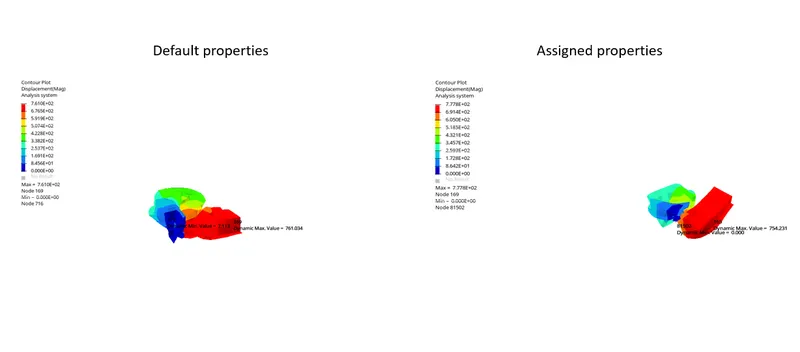
The displacement of beam model nodes is captured more appropriately in the assigned properties. We could see that the maximum value of the displacement capture by the assigned property is 754.231 when compared to the default property where it is 761.034. Also, the distribution of the stress and strain is more accurately captured using the Assigned properties.
Hourglass Energy
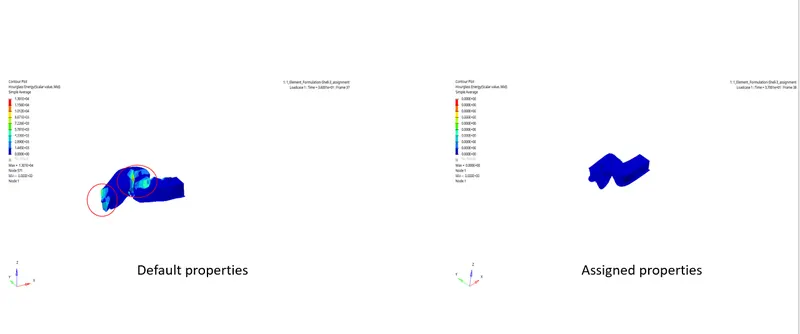
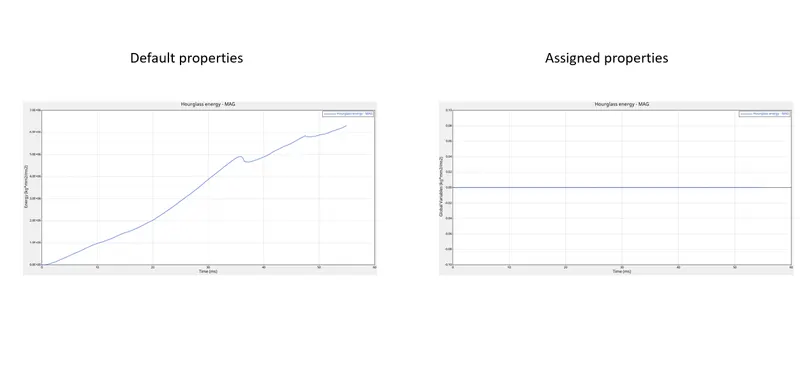
Hourglass deformation: When the under-integrated shell element is used i.e.) one integration point, which resists from detecting strain. Elements deform but with no strain and there would be no strain energy and the deformation are called hourglass energy or zero energy mode. The hourglass can be reduced by
1) Using stiffness to the modes.
2) Using artificial viscosity.
3) Using fully integrated elements.
4) Refining the mesh.
The other two methods in terms of element formulation are
1) Perturbation (Q4 elements)
2) Physical stabilization (QEPH element).
In this study the hourglass deformation is arrested using the physical stability QEPH element, which as discussed is an advanced under-integrated formulation when compared to perturbation which is fully integrated formulation. The QEPH has a better compromise to cost and quality when compared to Q4 elements. QEPH helps in reducing the accumulated hourglass deformation and is preferred to use for low-rate problem which includes the crash simulation. It has an artificial stiffness response and hence reduces the hourglass coefficient reducing the stiffening effect. On the other hand, the perturbation is based on stiffening method which may lead to shear locking.
Von mises stress
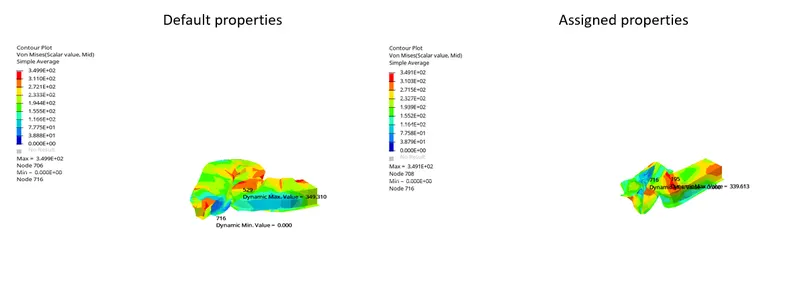
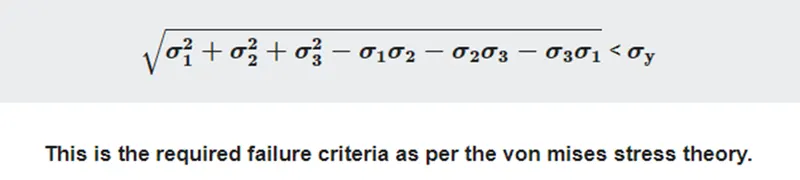
Von Mises stress is a value used to determine if a given material will yield or fracture. It is mostly used for ductile materials, such as metals. The von Mises yield criterion states that if the von Mises stress of a material under load is equal or greater than the yield limit of the same material under simple tension then the material will yield.
The Von mises stress at frame rate of 46 is compared. We could see that the default value reaches the maximum load value of 349.310N whereas the assigned properties show the distribution appropriately. At 46 the maximum load is 339N is obtained using the assigned properties.