Assignment 3
Objective
To simulate and compare the crash beam file with base and imporved shell element properties.
Procedure
- Base Simulation
- Import the first run_0000.rad file in the hypermesh.
- Edit the first run_0001.rad in the notepad.Change the run time to 55 ms from 60 ms as well the animation time from 1ms to 0.9167 ms so as to capture 60 animations files of the simulation.
- Check the shell element properties in the model.
- Save the model in a separate folder named first_run and the run the simulation.
- Recommended Properties
- Import the first run_0000.rad file in the hypermesh from the previous case.
- Edit the shell element properties from default settings to the recommended properties such as I_shell =24, I_smstr =2 ,I_sh3n = 2, number of integratiion points N=5, I_plas=1 and I_thick=1.
- Save the model in a separate folder named second_run and the run the simulation.
Error Check
The negative energy error increases from 0.1% to 10.3% as the simulation progresses for the base simulation and it remains constant at 0.1% for the recommended properties simulation. This error is caused due to hourglass energy which is not counted in the energy balance. For a normal under integrated elements, hourglass energy should be in the range of 10%-15% where as, for the QEPH shell formulation,error of +1% or +2% is acceptable.The negative energy error present in the base simulation is under 11% where as for the recommended properties is under 0.5%.Since the values are within the given range, the simulation results are acceptable.
Increase the nodal mass via /DT/NODA/CST is the easiest way to increase the time step of a model or prevent a time step from dropping below a certain value during the simulation. Adding too much mass affects the physics by increasing the kinetic energy of a drop or impact simulation.In general, it is recommended to keep the amount of mass added to less than 5%. The mass error for the simulation is of the order of 10^-3, hence it is acceptable.
Results
- Base Simulation
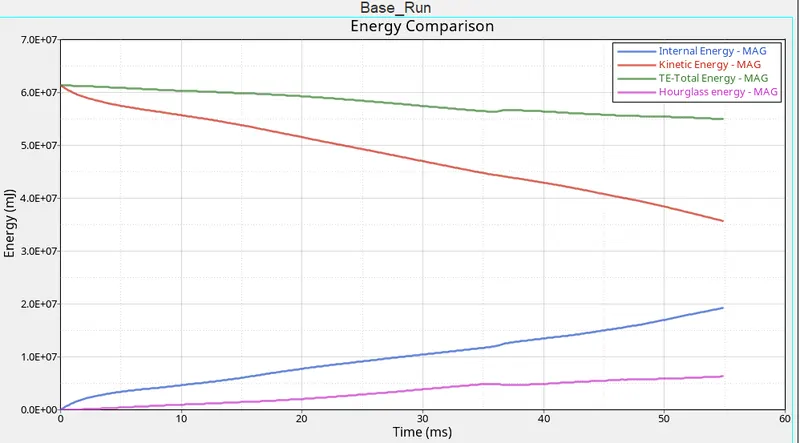
As the simulation progresses, the kinetic energy of the system gets converted into the internal energy, but there is some decrease in the total energy of the system which is absurd.This decrease of total energy gives rise to the negative energy called hourglass energy,being virtually added to the system.Hourglass energy is the energy generated by the addition of virtual forces into the system in the form of physical, viscous or stiffness forces .These forces are added to the elements having zero stain energy or the elements going into permanent deformantion with registering any kind of the stress/ strain in the system.This energy is not considered into the energy error calculations (being virtual), hence the negative sign arises.The summation of the hourglass energy along with the total energy gives us the constant total energy of the simulation.
- Recommended Simulation
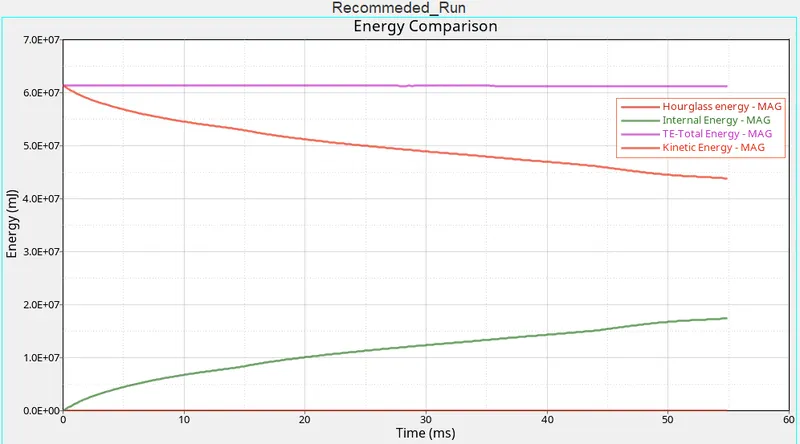
Unlike the previous case, the total energy of the system remains constant.Hence, all of the kinetic energy gets converted into the internal energy.The hourglass energy generated in the system is negligible.The use of element type I_shell = 24 is justified as there is almost no hourglass energy present in the system.This is because I_shell= 24 uses physical hourglass forces which eliminates almost all types of hourglass modes.
- Internal Energy
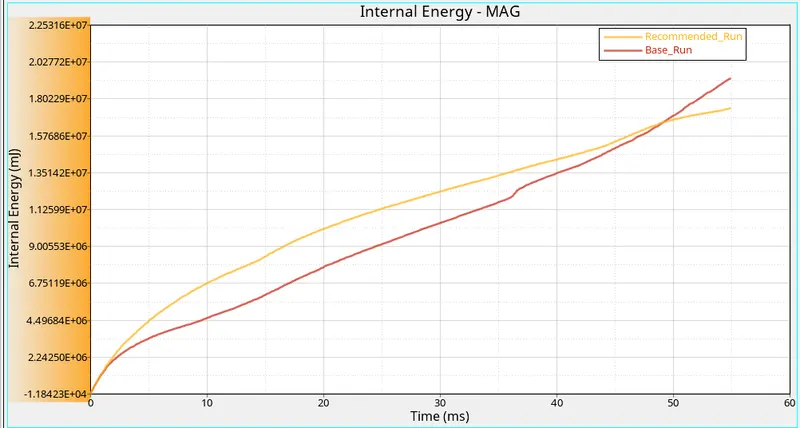
From the above graph, it is clear that the internal energy of the system increases with time.The only difference is in the slope of curve. The slope of the curve is less for recommended shell properties when compared to the base run.At the end of the 55ms,the internal energy for the base run is 19.28KJ where as for the recommended run is 17.46KJ.
- Kinetic Energy
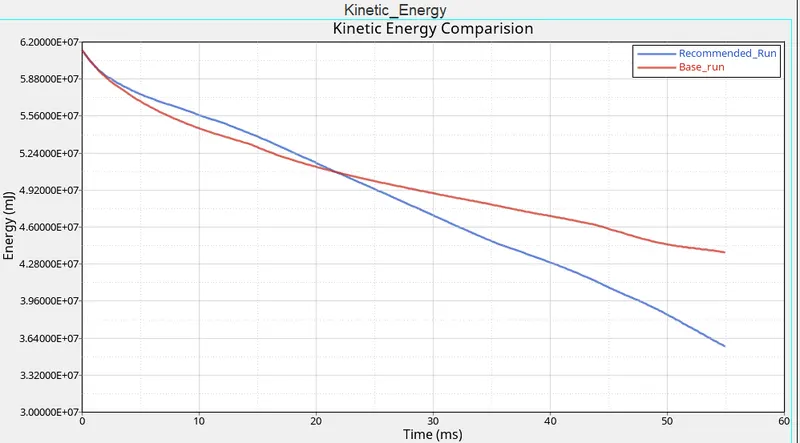
The kinetic energy decreases with time because the energy gets converted into internal energy.At the end of the 55ms,the kinetic energy for the base run is 43.79KJ where as for the recommended run is 35.68KJ.
- Total Energy
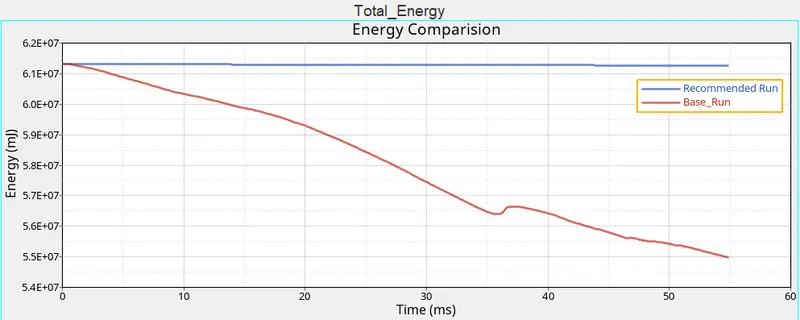
The total energy decreases with time for the base run, where as it stays constant for the recommended run.The decrease in energy gives rise to hourglass energy which is generated by the zero strain elements.At the end of the 55ms,the Total energy for the base run is 61.25KJ where as for the recommended run is 54.96KJ.
- Hourglass Energy
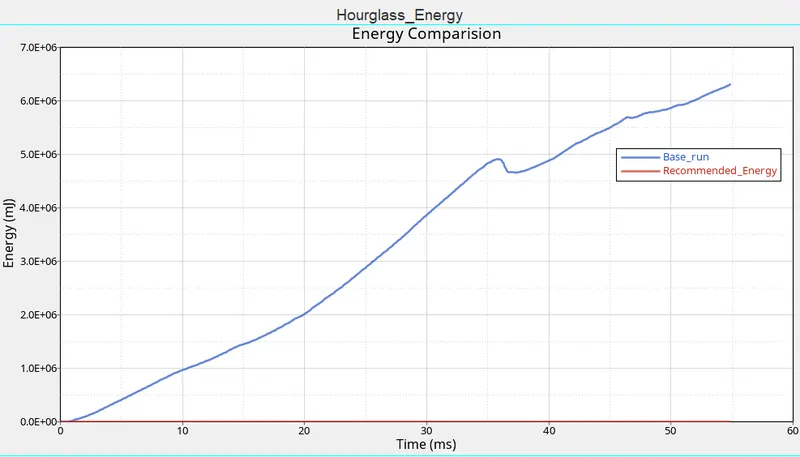
The hourglass energy increases with time for the base run simulation as it uses Flanagan-Belytschko formulation to calculate the hourglass resistance.The idea in the Flanagan-Belytschko formulation is to build an hourglass velocity field which always remains orthogonal to the physical element modes.