Assignment 2
SI Engine (Tutorial 1)
Objective:
- Run the case at 1800 rpm and list down important parameters
- Air flow rate
- BMEP
- BSFC
- In-cylinder pressure
- Increase the power output at 3600 rpm by 10%
Solution:
Case 1: 1800 RPM and 3600 RPM
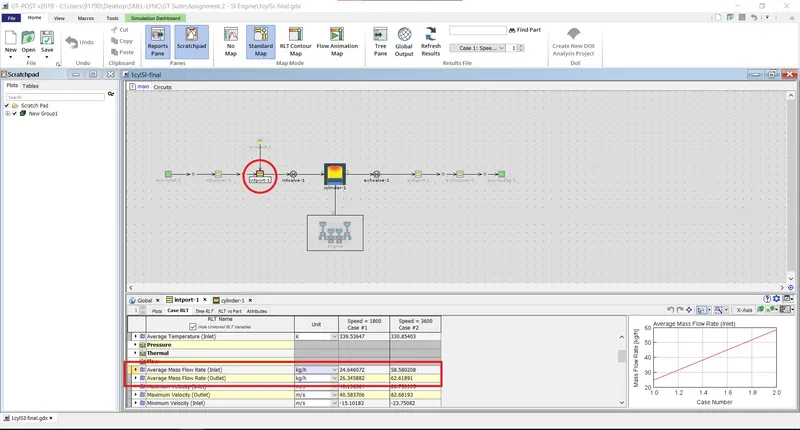
Air flow rate:
Air flow rate is measured at the inlet of intake port, which is equal to 24.64 kg/hr and at the outlet it is 26.34 kg/hr which is the sum of both air and fuel flow rate.
Brake Mean Effective Pressure (BMEP):
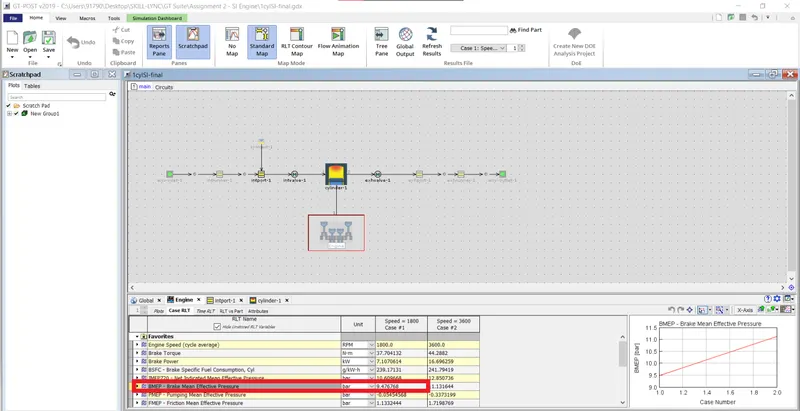
The Mean Effective Pressure (MEP) is a theoretical parameter used to measure the performance of an IC Engine. Brake mean effective pressure (BMEP) is the mean effective pressure calculated from the dynamometer power (torque).
For the case with RPM 1800, BMEP = 9.47 bar
Brake Specific Fuel Consumption (BSFC):
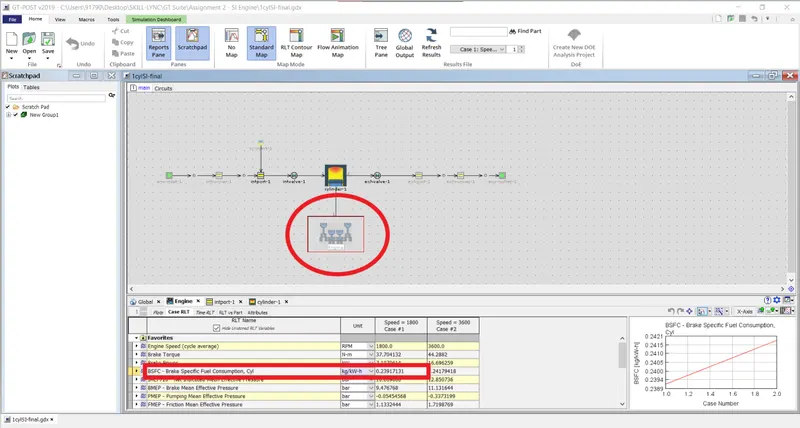
Dividing the fuel mass flow rate to the engine output power , we obtain the brake specific fuel consumption.
For the case with RPM 1800, BSFC = 0.2391 kg/kW-h
In cylinder pressure:
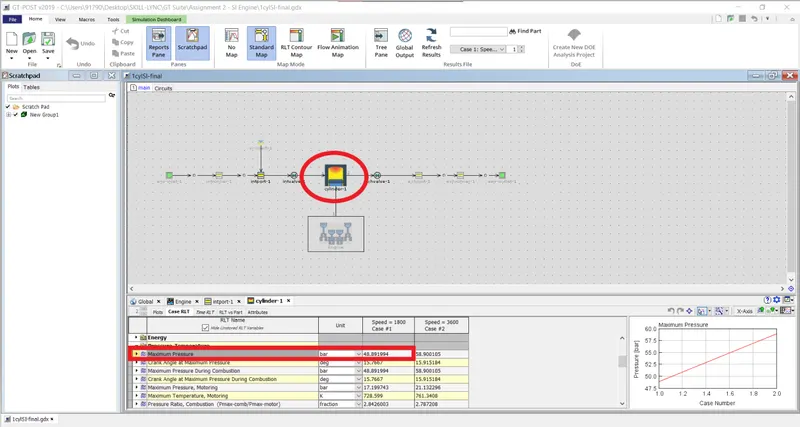
For the case with RPM 1800, in cylinder pressure = 48.89 bar
Case 2 :
Power output at 3600 RPM is 16.69kW
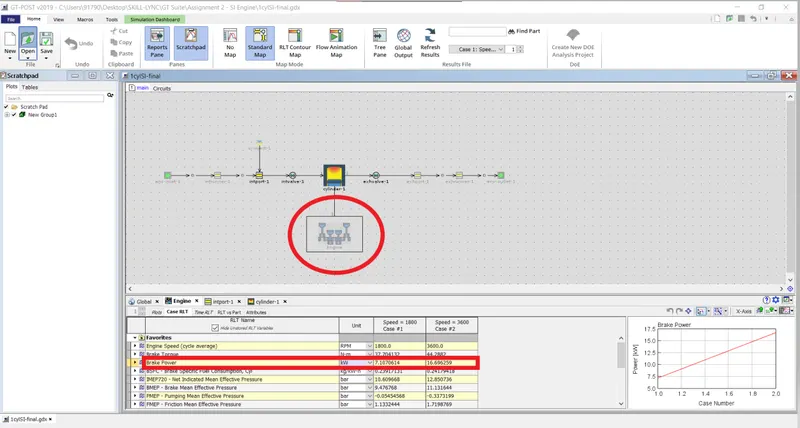
Increase in the power by 10% at 3600 RPM is 18.35 kW.
In order to achieve such an increase in power, geometry of cylinder can be altered which in turn influences the compression ratio. The increase in compression ratio should be such that it does not exceed 12 as it would induce knocking.
Desired increase in power 18.35 kW can also be carried out by following ways,
1. Making the Air Fuel Mixture more rich. (Equivalence Ratio gets altered, might decrease overall efficiency beyond a certain limit)
2. Altering the geometry of the cylinder.
Stroke length modification:
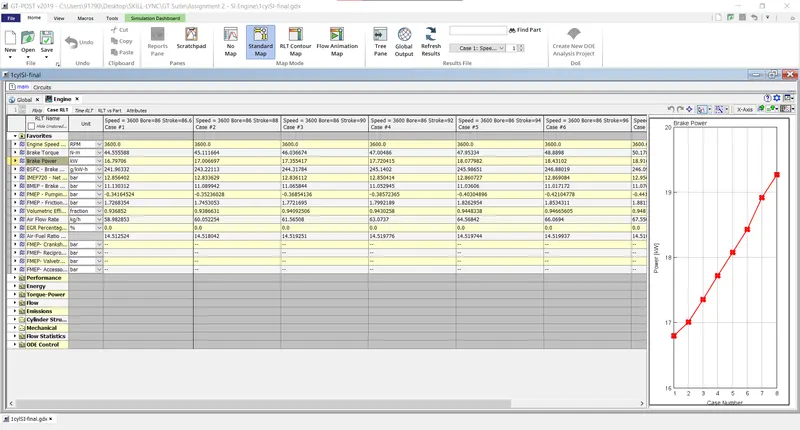
Here, bore dimensions are kept constant. So, after an increase of stroke length by almost 10mm (6 cases with 2mm step size), desired power of 18.43 ~= 18.35 kW is achieved.
Bore Modification:
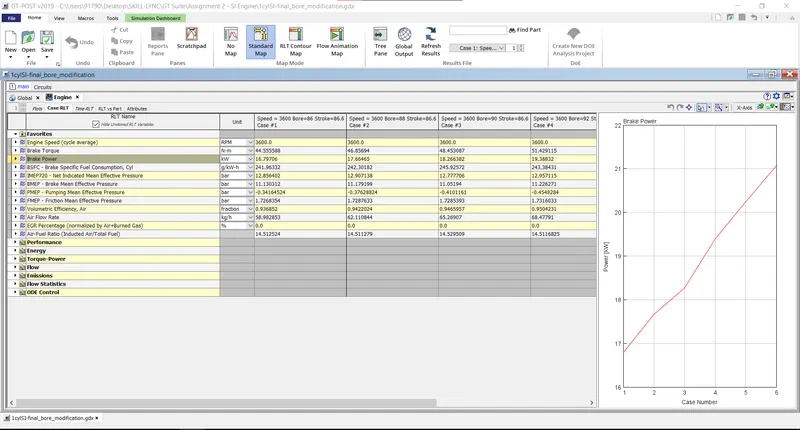
Here, Stroke Length dimensions are kept constant at 86.6 mm. Bore is increased from 86mm to 90mm (case 3 with 2mm step). Power of 18.26kW was achieved with just 4mm increase.
Conclusion:
Power can be increased through several techniques. Geometry Modification technique was applied and it is noticed that the change in bore provides a significant improvement in power than stroke length. It is due to the fact that the volume of stroke as well as clearance, depend on bore diameter in the order of 2. i.e., r^2.