Assignment 1
1. Explore the GUI of GT SUITE and list down modules available with brief description.
GT-SUITE is a multi-purpose platform with many physical libraries, containing both fundamental and higher-level components. Using these components, engineers are empowered to build system models of almost unlimited variety.
The foundation of GT-SUITE is a versatile multi-physics platform for constructing models of general systems based on many underlying fundamental libraries:
- Flow library (any fluid, gas or liquid or mixture)
- Acoustics library (both non-linear and linear)
- Thermal library (all types of heat transfer)
- Mechanical library (kinematics, multi-body dynamics, frequency domain)
- Electric and Electromagnetic library (circuits, electromechanical devices)
- Chemistry library (chemical kinetics)
- Controls library (signal processing)
- Built-in 3D CFD and 3D FE (thermal and structural)
2. Locate following settings:
- Time control flag
- Time step and solution control
- Integrator/Solver type
3. Explore intercooler tutorial and note down all settings of:
- Run setup
- Advanced setup
- Plot setup
- Output setup
4. Problem:
Given
- Diameter of cooler inlet and outlet pipe= 50 mm
- Length of the CAC= 1000 mm
- Inlet mass flow rate = 1200 kg/ h at 100 degC
- Outlet pressure 2 bar at 30 deg C
- Calculate the total heat transfer at Charge air cooler (CAC)
- Calculate pressure drop across CAC
SOLUTION:
Locating intercooler tutorial
setting up given input datum:
geometry data
flow rate
outlet data
Result:
the total heat transfer at Charge air cooler (CAC)
total heat transfer at Charge air cooler=746.128255228 J
pressure drop across CAC
conclusion:
An intercooler is a mechanical device used to cool a gas after compression. Compressing a gas increases its internal energy which in turn raises its temperature and reduces its density. An intercooler typically takes the form of a heat exchanger that removes waste heat in a gas compressor.[1] Intercoolers have a variety of applications, and can be found in air compressors, air conditioners, refrigeration, and gas turbines, and automotive engines, for example. They are widely known as an air-to-air or air-to-liquid cooler for forced induction (turbocharged or supercharged) internal combustion engines, used to improve volumetric efficiency. This is accomplished by increasing intake air density through nearly constant pressure cooling.
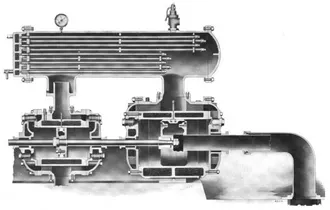
The given intercoller was simulated in 1d in GT-SUITE and the required results were plotted.