Advanced Sheet Metal Design Using NX Cad Challenge_1_Casing Design
Objective:
To design a sheet metal casing using NX-CAD software.
Introduction:
In this challenge, I will learn to design the casing design using the given master section by using advanced sheet metal commands in NX-CAD.
I used different features such as tab, normal cutouts, bend, flange, break corner, unbend, hole, dimple, bead, rebend, and flat pattern.
I'm going to design in the sequence and I used to create casing design by using sheet metal.
Features Used in Casing Design:
Sketch: XY Plane
Tab
Normal Cutout
Bend
Flange
Break Corner
Unbend
Sketch: Sketch Point
Hole
Sketch: Studio Spline
Studio Spline: Move Curve
Dimple
Bead
Mirror Feature
Rebend
Flat Pattern
Drafting
Base View
Design methodology:
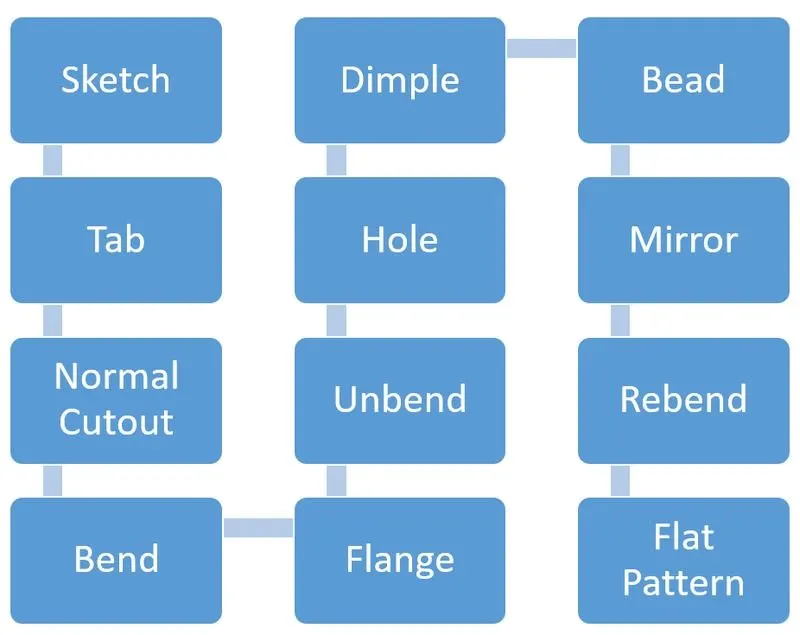
This project considers the features such as tab, cut-out, bends, flanges, unbends, holes, dimples, beads, mirror features, rebends, flat patterns, and drafting. The design methodology used for this challenge can be summarized as depicted in the flowchart mentioned above image.
Features Description:
Tab:
The tab is most used to design the base solid by using sheet metal.
Bend:
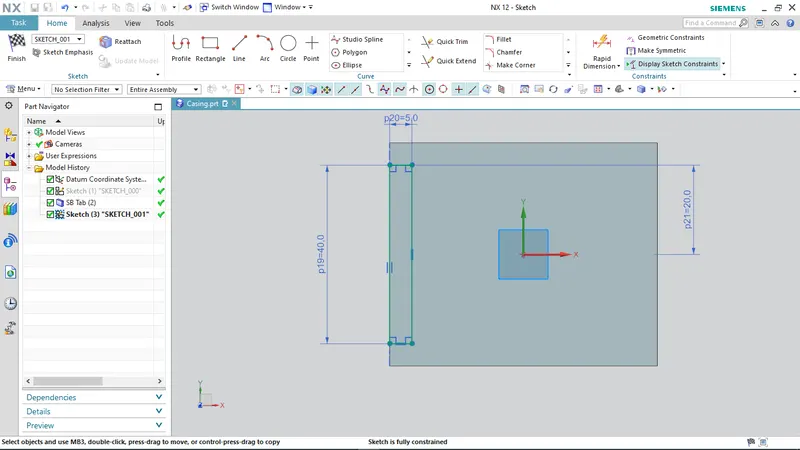
Individual bends change can be done for any bends in your part by resizing bend angle, resizing neutral factors, and resizing bend radius.
Flange:
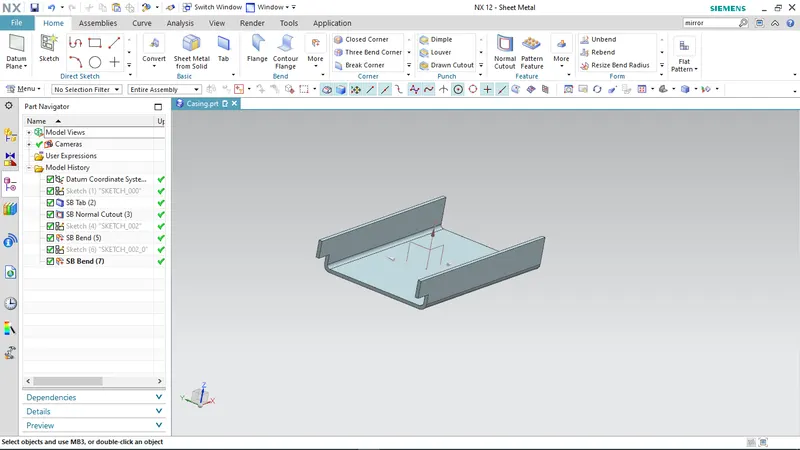
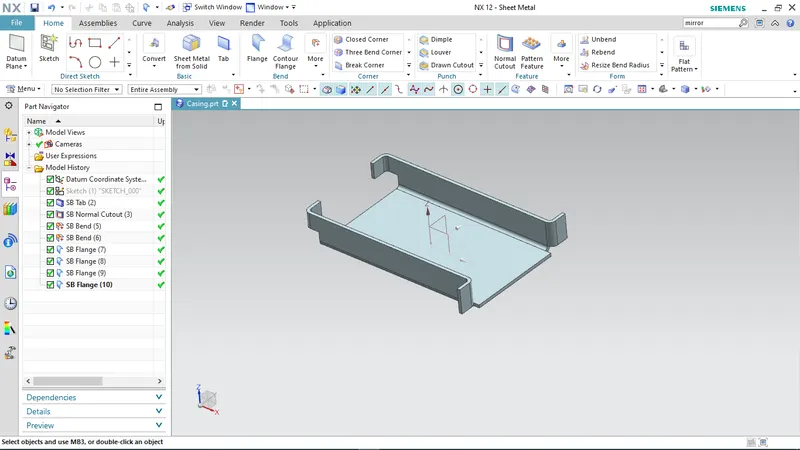
The flange is external or internal edges or rim for strength as the flange and selects the edge to add the flat flange.
Apply the same flange to the corresponding symmetric edge of the sheet metal.
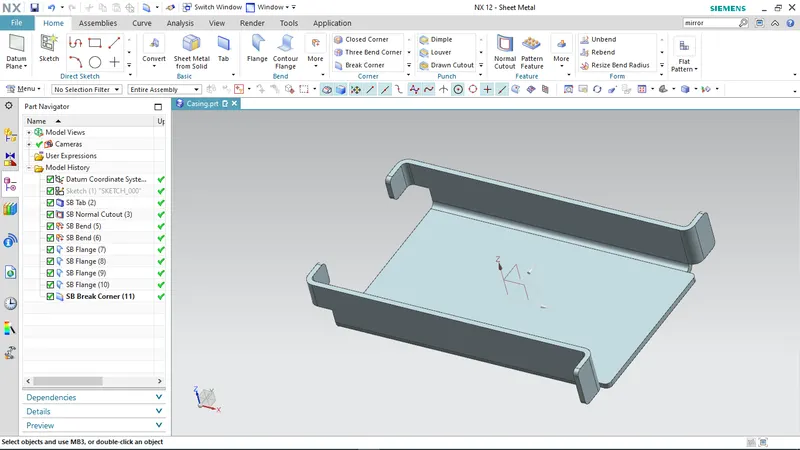
Break Corner:
The break corner feature breaks the sharp edge in the corner and makes it round.
The blend method is used to avoid the sharp edge.
Unbend:
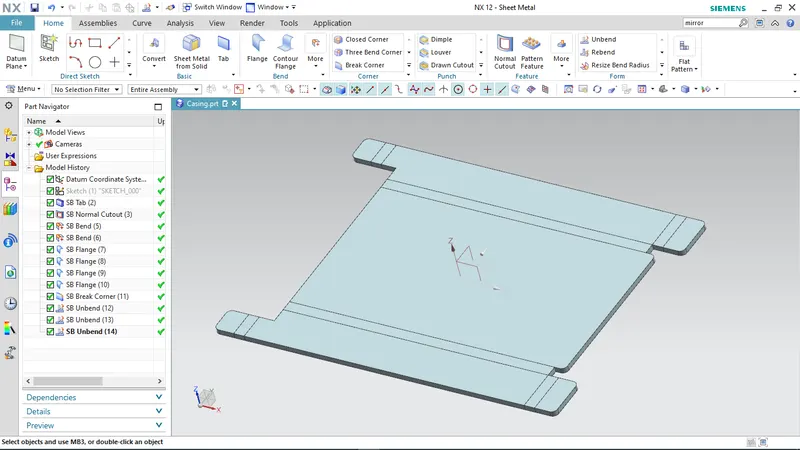
Unbend is a very useful tool in the NX-CAD. In the Unbend dialog box, select as stationary face the larger horizontal (inside the plane) face of the metal sheet.
Select the Bend face as one of its adjacent faces.
Hole:
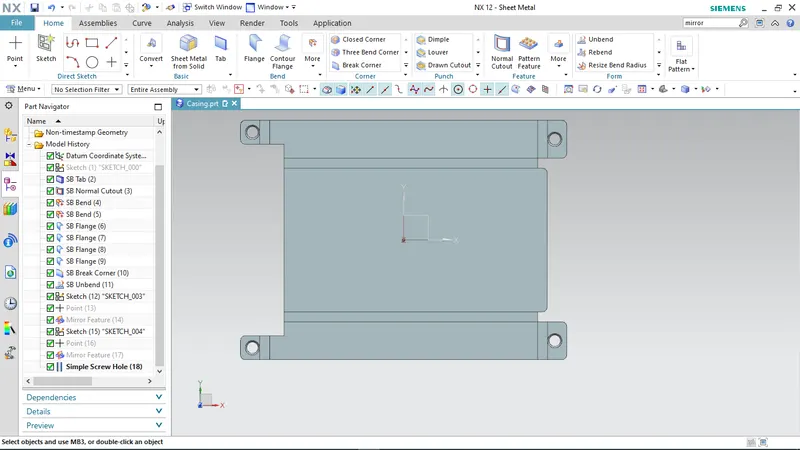
Hole Feature can be created simple, screw clearance hole and a fit. In the hole dialog box, use a screw clearance hole as a type with an M2 crew size and an H13 fit.
set the depth limit option to through the body.
Dimple:
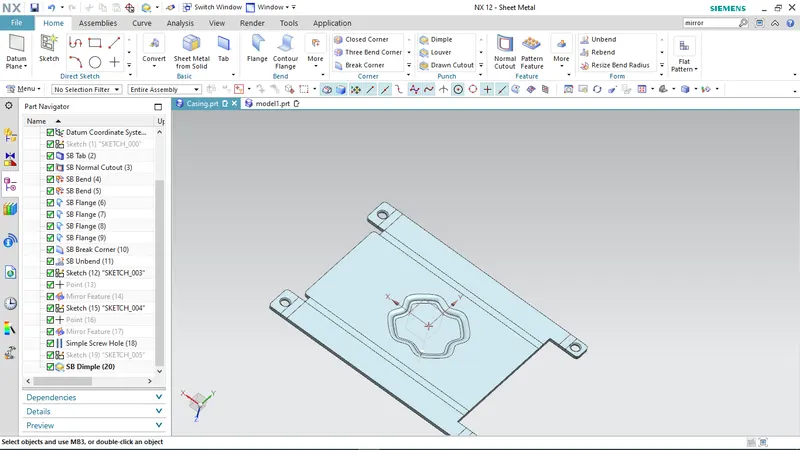
Use this feature to create a raised dimple feature in a sheet metal part. The dimple can be positioned on a flat face including flanges and extend in the direction of the face.
Dimple is also helped the sheet metal part to increase its stiffness.
Set the Depth option to 1 mm and sidewalls to material inside.
set all the parameters of the Rounding field to 1 mm.
Bead:
The Bead feature is used to create an embossed or engraved bead on the sheet metal part using a single entity.
Beads require a sketch to apply the feature.
Beads can be either an open or closed profile
Mirror Feature:
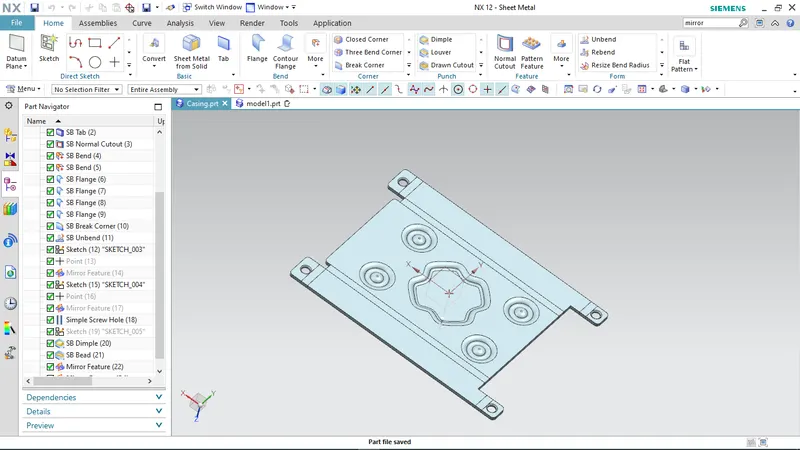
For this casing design, four small beads are applied in symmetric positions as shown in the image below.
The mirror feature is used to create opposite beads as shown in the image below.
Rebend:
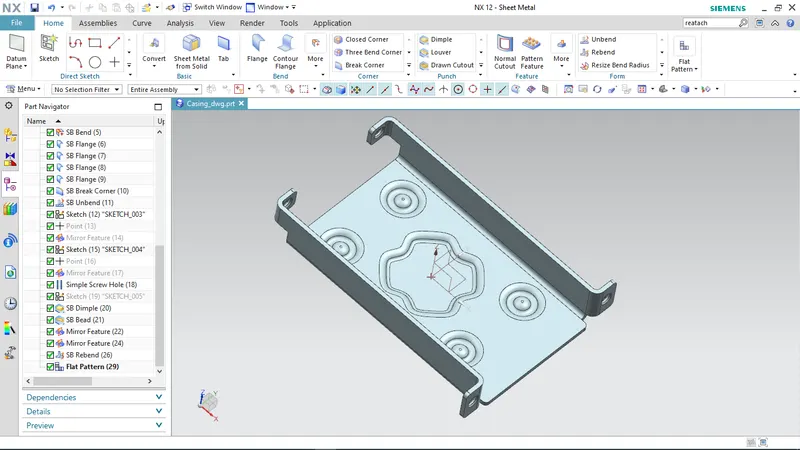
Rebend is used to bend from the unbend parts concerning the applied feature.
Sheet metal is used to be rebranded to its required shape.
Rebend the faces by selecting them in the reverse order.
Flat-Pattern:
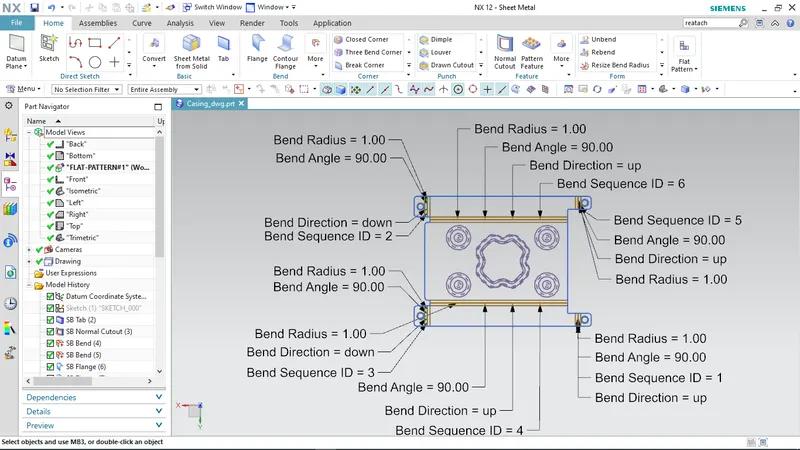
Select the central face of the metal sheet and validate.
Flat-pattern is the representation of the entire sheet metal component.
It removes the possible such as interference or collision within the same component.
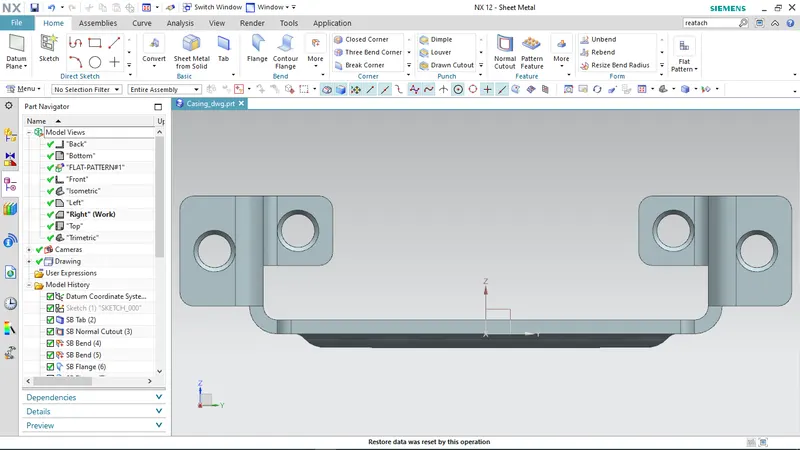
Various Views of Casing Design:
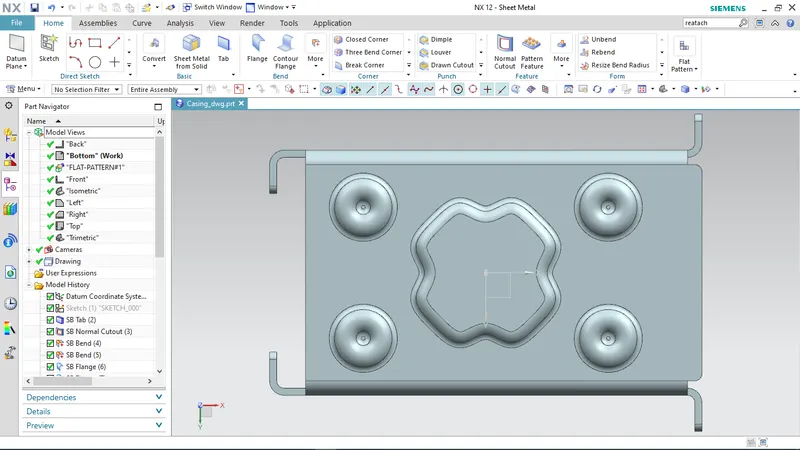
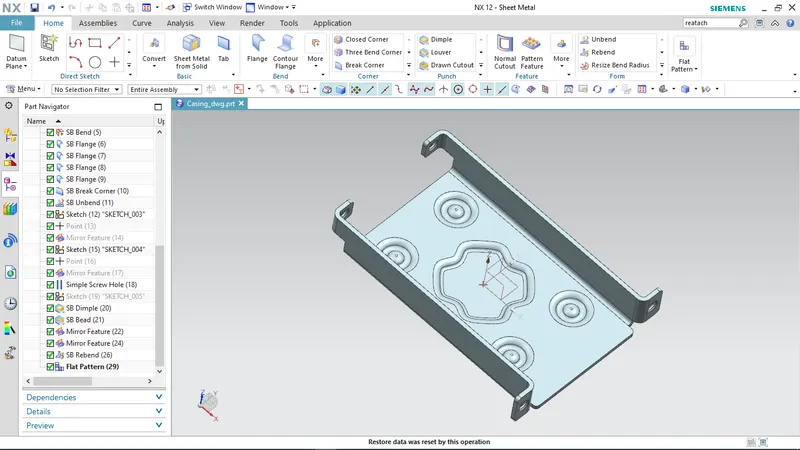
Draft:
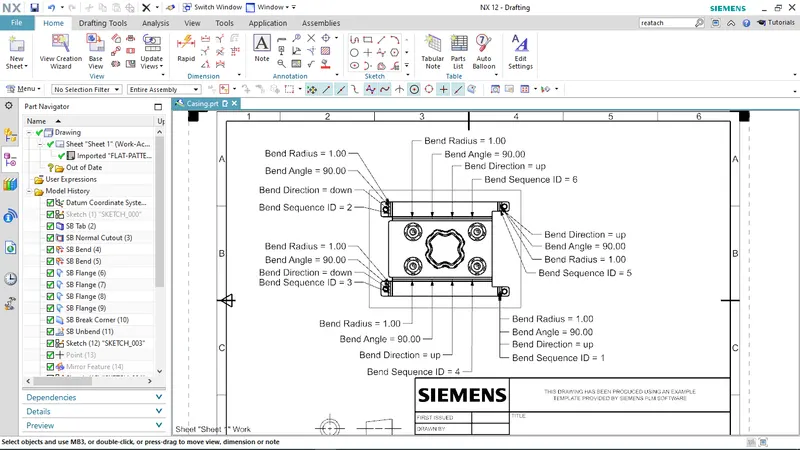
After the modeling, the manufacturing of the component a technical 2D drawing of the component with accurate dimensions or scales denoted.
The draft is created with a scale of 1:2 and using A4 size. and add a new Base View.
In the Base View dialog box, select the option Model View to use FLAT-PATTERN#1.
Set the scale ratio as 1:2.
Final Conclusion:
Casing Design is completed by using the sheet metal and its application.
All the basic features are prepared to create the casing design.
This challenge is finished by using NX-12.0