a new title
In this project, a literature review on shock flows & associated boundary conditions is to be done.
Introduction:
Shock waves are steep wavefronts that propagate in compressible fluids in which convection dominates diffusion. They are fundamental in nature, especially in high-speed fluid flows. Examples include transonic and/or supersonic shocks formed by supersonic flows impinging onto solid wedges, transonic shocks around supersonic or near-sonic flying bodies, bow shocks created by solar winds in space, blast waves caused by explosions and other shocks due to various natural processes. When a shock hits an obstacle, or a flying body meets a shock, shock reflection/diffraction phenomena occur.
Many such shock reflection/diffraction problems can be formulated as free boundary problems involving nonlinear partial differential equations (PDEs) of mixed elliptic–hyperbolic type. Understanding these shock reflection/diffraction phenomena requires a complete mathematical solution of the corresponding free boundary problems for nonlinear mixed PDEs. In this research, we show how several long-standing, fundamental multidimensional shock problems can be formulated as free boundary problems, discuss some recent progress in developing mathematical ideas, approaches and techniques for solving these problems, and present some further open problems in this direction. In particular, these shock problems include von Neumann's problem for shock reflection–diffraction by two-dimensional wedges with concave corner, Lighthill's problem for shock diffraction by two-dimensional wedges with convex corner, and Prandtl-Meyer's problem for supersonic flow impinging onto solid wedges. These problems are not only long-standing open problems in fluid mechanics, but also fundamental in the mathematical theory of multidimensional conservation laws. These shock reflection/diffraction configurations are the core configurations in the structure of global entropy solutions of the two-dimensional Riemann problem for hyperbolic conservation laws, whereas the Riemann solutions are the building blocks and local structure of general solutions, and determine global attractors and asymptotic states of entropy solutions, as time tends to infinity, for multidimensional hyperbolic systems of conservation laws. In this sense, we have to understand the shock reflection/diffraction phenomena in order to understand fully global entropy solutions to multidimensional hyperbolic systems of conservation laws.
We first focus on these problems for the Euler equations for potential flow. The unsteady potential flow is governed by the conservation law of mass and Bernoulli's law,
and
for the density ρ and the velocity potential Φ, where the Bernoulli constant B is determined by the incoming flow and/or boundary conditions, and h(ρ) satisfies the relation
with c(ρ) being the sound speed, and p is the pressure, which is a function of the density ρ. For an ideal polytropic gas, the pressure p and the sound speed c are given by p(ρ)=κργ and c2(ρ)=κγργ−1 for constants γ>1 and κ>0. Without loss of generality, we may choose κ=1/γ to obtain
This can be achieved by the following scaling: (t,x,B)→(α2t,αx,α−2B) with α2=κγ. Taking the limit γ→1+, we can also consider the case of isothermal flow (γ=1), for which
Shock reflection–diffraction
We are first concerned with von Neumann's problem for shock reflection–diffraction. When a vertical planar shock perpendicular to the flow direction x1 and separating two uniform states (0) and (1), with constant velocities (u0,v0)=(0,0) and (u1,v1)=(u1,0), and constant densities ρ1>ρ0 (state (0) is ahead of or to the right of the shock, and state (1) is behind the shock), hits a symmetric wedge
head-on at time t=0, a reflection–diffraction process takes place when t>0. Then, a fundamental question is what type of wave patterns of reflection–diffraction configurations may be formed around the wedge. The complexity of reflection–diffraction configurations was first reported by Mach in 1878, who first observed two patterns of reflection–diffraction configurations: regular reflection (two-shock configuration; figure 1a) and Mach reflection (three-shock/one-vortex-sheet configuration; figure 1b). The issues remained dormant until the 1940s when John von Neumann, as well as other mathematical/experimental scientists began extensive research on shock reflection–diffraction phenomena, owing to their importance in applications. It was found that the phenomena are much more complicated than what Mach originally observed: the Mach reflection can be further divided into more specific subpatterns, and various other patterns of shock reflection–diffraction configurations may occur, such as the double Mach reflection, von Neumann reflection and Guderley reflection. Thus, the fundamental scientific issues include the following:
- (i) structure of the shock reflection–diffraction configurations;
- (ii) transition criteria between the different patterns of shock reflection–diffraction configurations; and
- (iii) dependence of the patterns upon physical parameters such as the wedge angle θw, the incident-shock-wave Mach number and the adiabatic exponent γ≥1.
(a) Regular reflection; (b) simple Mach reflection; and (c) irregular Mach reflection.
In particular, several transition criteria between the different patterns of shock reflection–diffraction configurations have been proposed, including the sonic conjecture and the detachment conjecture by von Neumann.
However, most of the fundamental issues for shock reflection–diffraction phenomena have not been understood, especially the global structure and transition between the different patterns of shock reflection–diffraction configurations. This is partially because physical and numerical experiments are hampered by various difficulties and have not yielded clear transition criteria between the different patterns. In particular, numerical dissipation or physical viscosity smear the shocks and cause boundary layers that interact with the reflection–diffraction patterns and can cause spurious Mach streams. Furthermore, some different patterns occur when the wedge angles are only fractions of a degree apart, a resolution that even sophisticated modern experiments have not been able to reach. For this reason, it is almost impossible to distinguish experimentally between the sonic and detachment criteria, as pointed out in. In this regard, the necessary approach to understand fully the shock reflection–diffraction phenomena, especially the transition criteria, is still via rigorous mathematical analysis. To achieve this, it is essential to formulate the shock reflection–diffraction problem as a free boundary problem and to establish the global existence, regularity and structural stability of its solution.
Mathematically, the shock reflection–diffraction problem is a multidimensional lateral Riemann problem in domain .
Shock diffraction (Lighthill's problem)
We are now concerned with shock diffraction by a two-dimensional wedge with convex corner (Lighthill's problem). Consider a plane shock in the coordinates (t,x), , with left state (ρ,u,v)=(ρ1,u1,0) and right state (ρ0,0,0) satisfying u1>0 and ρ0<ρ1, going from left to right along a wedge with convex corner
The incident shock interacts with the wedge as it passes the corner, and then shock diffraction occurs. The mathematical study of the shock diffraction problem dates back to the 1950s with the work of Lighthill via asymptotic analysis.
When the wedge angle becomes smaller, several other difficulties arise. Owing to the concave corner of the solution domain at the origin, more technical arguments are required to obtain the existence of solutions to the modified problem. From this modified condition, the Dirichlet condition is assigned on the shock where the modified uniform oblique condition fails. Thus, the uniform boundedness of solutions is required to be controlled more carefully. Finally, the existence of shock diffraction configuration is established.
Prandtl–Meyer reflection configurations and free boundary problems
We now consider Prandtl-Meyer's problem for unsteady global solutions for supersonic flow onto a solid ramp, which can also be regarded as portraying the symmetric gas flow impinging onto a solid wedge (by symmetry). For a steady supersonic flow past a solid ramp whose angle is less than the critical angle (called the detachment angle) θdw, Prandtl employed the shock polar analysis to show that there are two possible configurations: the weak shock reflection with supersonic or subsonic downstream flow and the strong shock reflection with subsonic downstream flow, which both satisfy the physical entropy conditions, provided that we do not impose additional conditions downstream.
The fundamental question of whether one or both of the strong and the weak shocks are physically admissible has been vigorously debated over the past seventy years, but has not yet been settled in a definite manner. On the basis of experimental and numerical evidence, there are strong indications that it is the weak reflection that is physically admissible. One plausible approach is to single out the strong shock reflection by the consideration of stability: the stable ones are physical. It has been shown in the steady regime that the weak reflection is not only structurally stable, but also L1-stable with respect to steady small perturbation of both the ramp slope and the incoming steady upstream flow, whereas the strong reflection is also structurally stable for a large spectrum of physical parameters.
We are interested in the rigorous unsteady analysis of the steady supersonic weak shock solution as the long-time behaviour of an unsteady flow and establishing the stability of the steady supersonic weak shock solution as the long-time asymptotics of an unsteady flow with the Prandtl–Meyer configuration for all the admissible physical parameters for potential flow. Our goal is to find a solution (ρ,Φ) to system (1.1) and (1.2) when a uniform flow in with , is heading towards a solid ramp at t=0:
The shock reflection/diffraction problems for the full Euler equations
When the vortex sheets and the deviation of vorticity become significant, the full Euler equations are required. Here, we present a mathematical formulation of the shock reflection/diffraction problems for the full Euler equations and the role of the potential theory for the shock problems even in the realm of the full Euler equations. In particular, the Euler equations for potential flow, are actually exact in an important region of the solutions to the full Euler equations.
The full Euler equations for compressible fluids in , are of the following form:
where ρ is the density, v=(u,v) the fluid velocity, p the pressure and e the internal energy. Two other important thermodynamic variables are the temperature θ and the energy S. The notation a⊗b denotes the tensor product of the vectors a and b.
Choosing (ρ,S) as the independent thermodynamic variables, then the constitutive relations can be written as (e,p,θ)=(e(ρ,S),p(ρ,S),θ(ρ,S)) governed by
For a polytropic gas,
or equivalently,
where R>0 may be taken to be the universal gas constant divided by the effective molecular weight of the particular gas, cv>0 is the specific heat at constant volume, γ>1 is the adiabatic exponent, and κ>0 is any constant under scaling.
Conclusion
As we have discussed above, the three long-standing, fundamental transonic flow problems can be all formulated as free boundary problems. Understanding these transonic flow problems requires a complete mathematical solution of these free boundary problems. Similar free boundary problems also arise in many other transonic flow problems, such as steady transonic flow problems including transonic nozzle flow problems, steady transonic flows past obstacles, supersonic bubbles in subsonic flow, local stability of Mach configurations, as well as the higher-dimensional version of problem (shock reflection–diffraction by a solid cone) and problem(supersonic flow impinging onto a solid cone). We have discussed recently developed mathematical ideas, approaches and techniques for solving these free boundary problems. On the other hand, many free boundary problems arising from transonic flow problems are still open and demand further developments of new mathematical ideas, approaches and techniques.
Source: https://www.ncbi.nlm.nih.gov/pmc/articles/PMC4535264/
Physics behind Shock Waves:
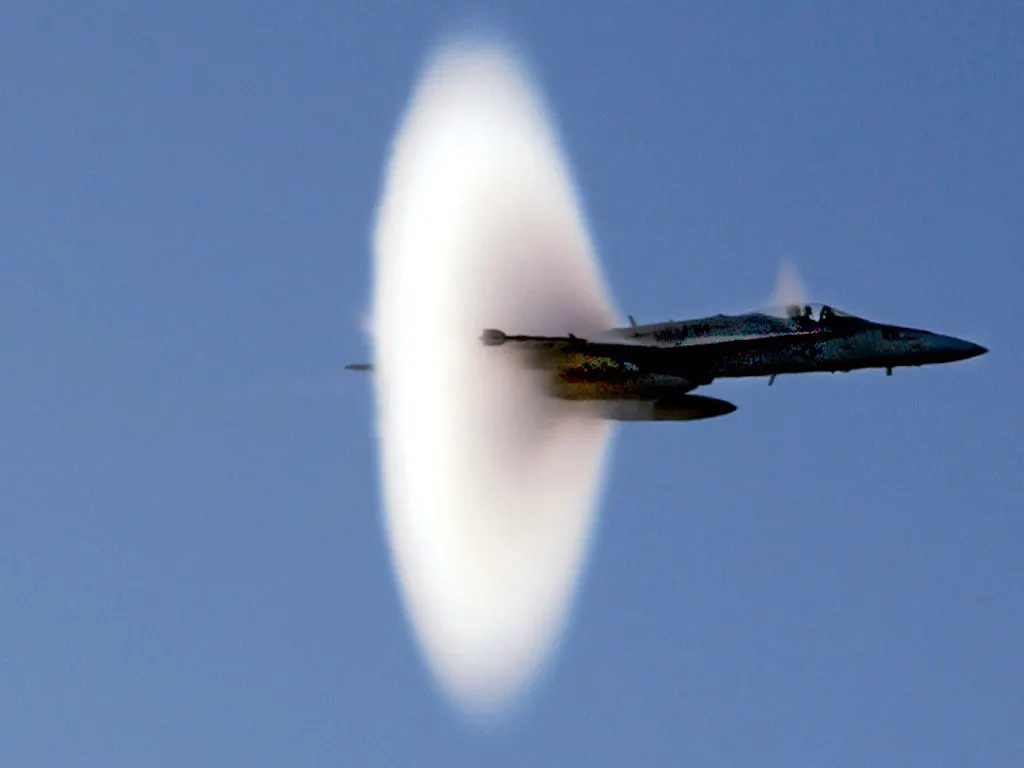
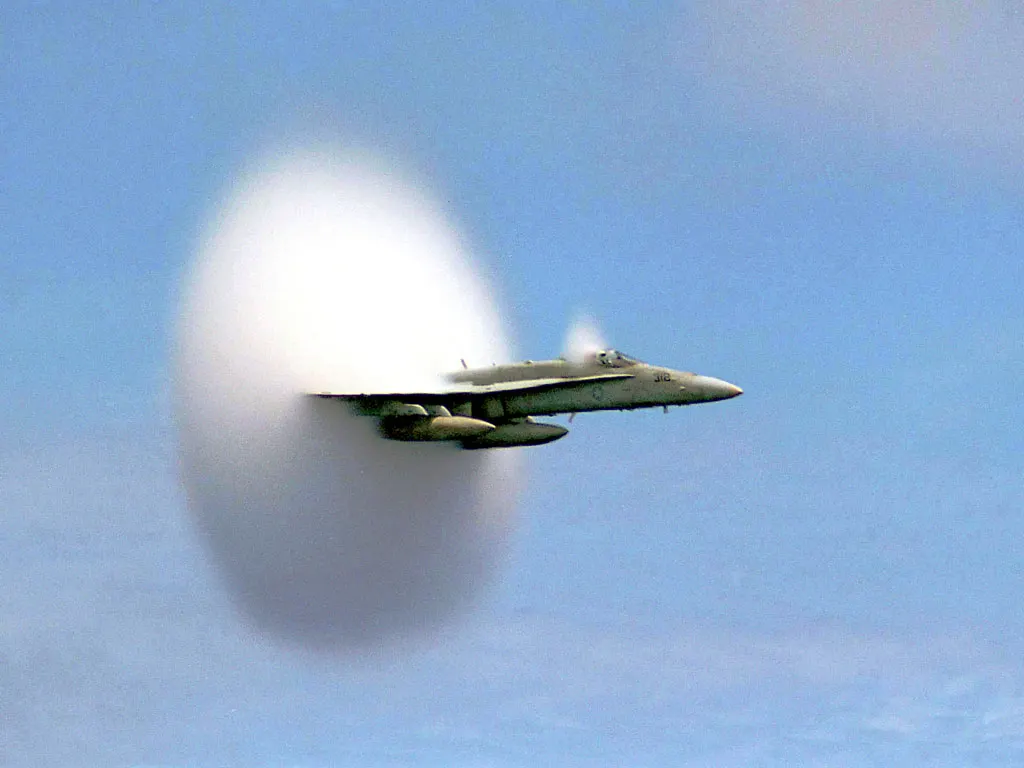
When the speed of a source equals the speed of sound (v = c) the wave fronts cannot escape the source. The resulting pile of waves forms a large amplitude "sound barrier" that makes sustained flight at this speed difficult and risky.
The term "sound barrier" or "sonic barrier" first came into use during World War Two. Fighter pilots engaged in high speed dives noticed several irregularities as flying speeds approached the speed of sound: aerodynamic drag increased markedly, much more than normally associated with increased speed, while lift and maneuverability decreased in a similarly unusual manner. Pilots at the time mistakenly thought that these effects meant that supersonic flight was impossible; that somehow airplanes would never travel faster than the speed of sound. They were wrong.
When the speed of a source exceeds the speed of sound (v > c) the wave fronts lag behind the source in a cone-shaped region with the source at the vertex. The edge of the cone forms a supersonic wave front with an unusually large amplitude called a "shock wave". When a shock wave reaches an observer a "sonic boom" is heard.
[insert N-wave discussion]
Unlike ordinary sound waves, the speed of a shock wave varies with its amplitude. The speed of a shock wave is always greater than the speed of sound in the fluid and decreases as the amplitude of the wave decreases. When the shock wave speed equals the normal speed, the shock wave dies and is reduced to an ordinary sound wave.
 |  |
The ratio of the speed of a moving object (v) to the speed of sound (c) in a fluid is known as the Mach number in honor of Ernst Mach (1838–1916), the Moravian physicist, psychologist, and philosopher who studied sound and ballistics.
| M = | v |
| c |
The Mach number is a dimensionless measure of speed common in aerodynamics. Mach 0.5 is half the speed of sound, Mach 2 is twice the speed of sound, and so on. Speeds less than the speed of sound have a Mach number between zero and one and are described as subsonic. Those greater than the speed of sound have Mach numbers greater than one are a described as supersonic. Speeds approximately equal to the speed of sound have Mach numbers approximately equal to one and are described as transonic.
The shock wave from a supersonic object is a cone composed of overlapping spherical wavefronts. As any one of these wavefronts forms, it propagates radially outward at speed cand acquires a radius ct. At the same time the source, traveling at speed v moves forward vt. These two displacements form the leg and hypotenuse, respectively, of a right triangle and can be used to determine the Mach angle at the vertex of the shock cone.
| sin θ = | c |
| v |
When an object travels slower than sound, the ratio in this equation is greater than one, and the equation does not have a real solution. This makes absolute sense as there is no shock wave to speak of at subsonic speeds. Traveling at the speed of sound makes the ratio equal one and results in a Mach angle of ninety degrees. At transonic speeds the shock wave is a wall of high pressure moving with the object, perpendicular to its velocity. Above the speed of sound, the ratio is less than one and the Mach angle is less than ninety degrees. The faster the object moves, the narrower the cone of high pressure behind it becomes. Measuring the vertex angle is thus a simple way to determine the speed of a supersonic object.
Source: https://physics.info/shock/
comments:
Good work but It would have been better if you had added images from the plots that you got after performing the prandl meyer flow in converge