Week 3 - Units of quantities
1.) Kinematic viscosity- It is the ratio of Dynamic viscosity to the density of the fluid. A quantity in which force is not involved.
v = Dynamic viscosity (mu)/ Density of fluid (rho).
Its theoretical S.I unit is m^2/s, or stokes(st), 1 (st) stokes = 10^-4 m^2/s.
2.) Dynamic viscosity- The force needed by a fluid to overcome its own internal molecular friction so that it can flow.
Dynamic viscosity `μ`=`τ / γ`
where `τ = shearing stress in fluid(n/m^2) and γ= shear rate.(s^-1)
SI unit of dynamic viscosity is Ns/m^2.
3.) Peclet number- It is the ratio of thermal energy convected to the thermal energy conducted inside a fluid ,
PE= Heat transfer by convection/ Heat transfer by conduction. It is a dimensionless number used in convective heat transfer and is the product of the reynolds and prandtl number.
4.) Nussel Number- It is the ratio of convective to conductive heat transfer across the boundary of a fluid,
Nu= hxL/k ,where h is convective heat transfer coefficient, L is characteristic length and K is thermal conductivity of the fluid. If the nusselt number is low i.e close to 1 it is termed as laminar flow, If it is large between 100-1000 it is called as turbulent flow.
5.) Momentum Flux- It is the rate of change of momentum flowing through a unit area
the unit is force per unit area N/m^2.
6.) Fouriers Law of heat Conduction- The heat transfer rate through a material is propotional to the negetive gradient of temprature and its area.
Q`= -kA(dT/dx), where Q is heat transfer rate (W), K is thermal conductivity(W/mK),A is cross-sectional area (m^2) and dT/dx is temprature gradient(K/m). Its SI unit is watts(W).
7.) Fick's Laws of Diffusion- (i)The molar flux due to diffusion is proportional to the concentration gradient, J = -X(dC/dx) where J is the flux(cm^-2 s^-1), X is diffusivity constant(cm^2/s) and dC/dx is the concentration gradient(cm^-4).
(ii) The rate of change of concentration at a point in space is proportional to the second derivative of concentration with space, 
where dC/dt is cm^-3.s^-1.
8.) Wall shear stress  is given by
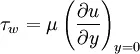
where  is the dynamic viscosity, is the flow velocity parellel to the wall and
  is the distance to the wall.
The SI unit of wall shear stress is Pa which is identical to  .
.
9.) Gradient of Temprature Field- Assuming That temprature is a scalar quantity that is a continuous and differentiable function of 3-D space (A temprature field) Then

where x,y and z are the cordinates of area of interest then the temprature gradient is the vector quantity defined as
 .
.
It is a vector quantity because when the nabla operator is used on a scalar quantity the product is a vector quantity.
10.) Divergence of velocity field- Let F= Ui + Vj + Wk(velocity field) Then
The dot product of nabla and a vector field is always a scalar quantity.