Car Hood Design
A
Report
On
Hood Design
By Abhishek Gangurde
Hood design
Objective:
- Design Outer Panel with the Hem
- Develop the Inner Panel
- Develop all the Necessary Reinforcements
- Mirror and position the Hinge & Striker
- Provide Mastic Data
- Provide the required Emboss definition
- Develop a detailed Report for the Mastic position and Embossed you have placed
Master section for development of hood
INTRODUCTION:
Bonnet is main component of a car at the front portion.The Hood or the Bonnet of a car is considered as the frontal BIW enclosure component. Bonnets are designed to reduce air resistance as the air flows around the car. It is used to decorate the car and add luxurious look. The shape of the bonnet is made aerodynamic in order to minimize the air effect. Bonnet is generally used to access the parts easily such as radiator, engine and many other parts. In automotive world the weight optimization plays an important role.
In recent years, the work has been done on the bumper and hood design of the vehicle front end to reduce the injuries to the pedestrians in the event of a pedestrian vehicle collision. The front portion of the vehicle gets damaged including bonnet when met with an accident. So there is need to c
Purpose of Hood Design:
- Save and safety of purposes inside the car.
- Cover all engine parts and radiators.
- Reduce the Air effect due to design aerodynamic shape.
- provide access to the engine for repair and maintenance.
- reduces engine noise, providing you with a quieter drive.
- It can also help keep the paint underhood last longer.
Material used for Hood :
Hood is typically made out of steel or aluminum, although aftermarket manufacturers may manufacture hoods out of fiberglass, carbon fiber, or dry carbon.
- Grade 304 stainless steel and Grade 302 mild steel for the outer and inner panel.
- Flex fiber or reinforcement vinyl ester composite for Latch.
- Elastomer /silicon Polymer and Silicon copper paste for mastic seal.
Design Consideration
As discussed in the earlier section, the hood plays a critical safety function in an automobile, not only for the occupants of the vehicle but also for the pedestrian. Hence, a lot goes in while designing the hood and must be compliant with the standards and considerations. In this project, the European New Car Assessment Programme, popularly know as EuroNCAP, was followed to understand the consideration and standards one must follow while designing a hood. EuroNCAP plays an instrumental role in raising awareness on safe and effective design for the pedestrian. It programs and develops test series and rating systems for accessing design safety for pedestrian during impact with a vehicle. The tests are generally executed for vehicle hit speed at around 40 km/h and covers the pedestrian body interaction with the vehicle upon collision.
Below represented chart throws light on some of these considerations for the frontal crash of a vehicle with a pedestrian.
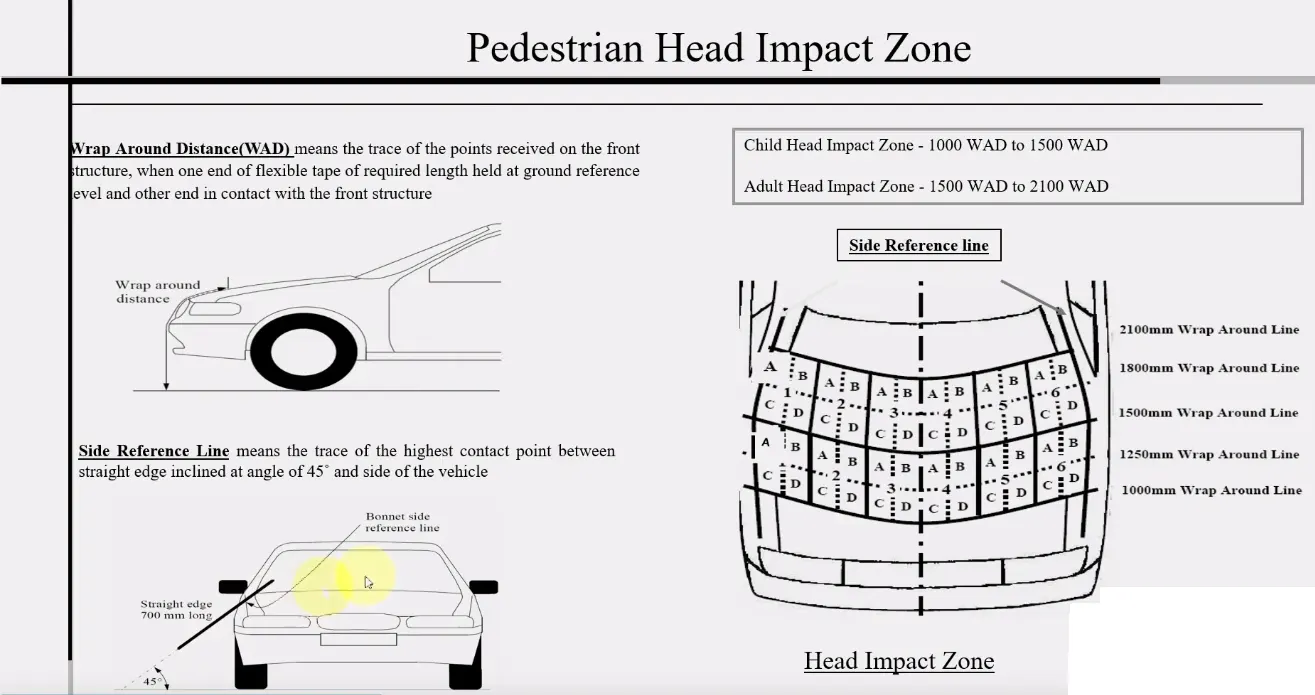
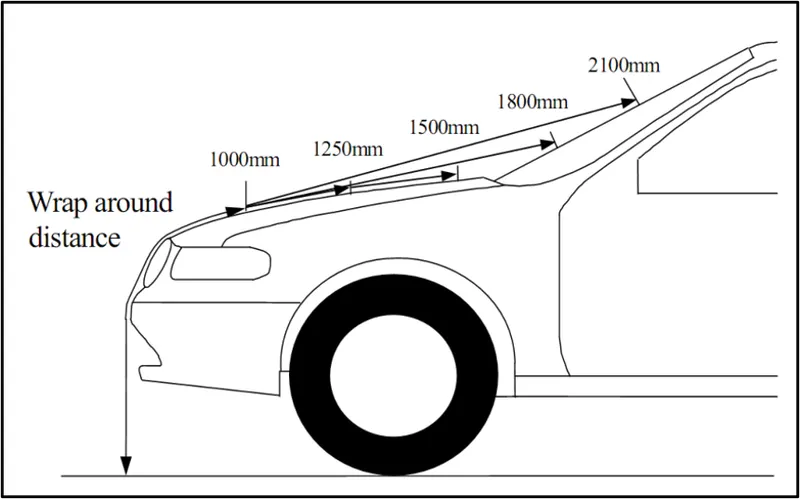

As we could see the impact region, based on these impact regions the thickness of the hood at those regions are reduced to allow softer landing and lower impact. Upon impact of the pedestrian, the hood in those regions should absorb and dissipate the energy allowing deformation and hence collapsing, which in turn would result in a lower impact on the pedestrian.
At the same time, the impact on the vehicle should be channeled outside the vehicle to safeguard the occupants from severe injuries. Based on these considerations, the inner panel should be embossed with strategized channels and empty cut-outs to allow for maximum absorption of such impacts.
HOOD OPENING ANGLE:
It is one of the major criteria in designing the hood of a car. The opening angle of the hood is varying from place to place and from country to country. It is designed based on the average height of the people in the country.
Data to be used:
Hood Thickness Information
- Outer Panel Thickness = 0.75mm
- Inner Panel Thickness = 0.75mm
- Reinforcement Thickness = 1.5mm
Outer Panel with the Hem
Hem is provided to the upper panel of the hood at the corner to provide the better grip between inner panel and outer panel of hood
The clearance between Hem and inner panel should be near about 0.5 mm
Outer panel is nothing but a outer skin of inner panel. Otherwise called as a cover of inner panel. It is the part, which gives luxurious look to the hood or bonnet. Outer pannel and inner pannel cannot join by any welding process like spot welding or rivet, which spoil
the outer look of a car.The outer pannel is generally extracted model from the prototype design.
Inner Panel
Inner panel designer so as to appear better visualization, better view for the customer and one is to meet customer requirement of them by considering engineering fundamental behind hood design.
It should have some feature like emboss at the hinge point which provides the better strength to the inner panel of hood.
Inner panel supports outer panel. It consists of different embosses and hole at different places. Embosses provide stiffness as well as dissipate energy towards hinges. To determine the most effective position of hole, the method of modal stiffness is employed.Inner
panel is offset of the parent work surface.inner pannel thickness is 0.75mm.
Positioning the Hinge & Striker
Positioning of hinge and striker such that there is perfect tangent relation of latch and trajectory of hood movement if it does not satisfy this condition there is problem occurs during engagement of the hood with engine compartment, then we have to adjust the hinge and latch position to achieve this relation.
Mastic Data
Mastic data should be provided in between hood upper panel and inner panel to achieve better NVH Range, to avoid the spot weld, to maintain the upper hood surface regularity.
Generally mastic diameter should be about 80mm which called strengthen diameter of the mastic rubber.
Dotted circle shown in figure indicate mastic position.
The required Emboss definition
Emboss is created such that when force induced in middle of the hood which directly transmitted to the hinge point to provide better safety. If this type of emboss not provided the force transmission towards the centre of hood or vehicle which causes serious damage,
Figure shows the emboss and force transmission/distribution in inner panel.
https://drive.google.com/open?id=18wgRE4iBNYGHHFiMB3I4geZiT7LDwG6e