Problem set 2 -week 3 challenge
1.
The following parameters were given as inputs for the given challenge and the respective variables are assigned.
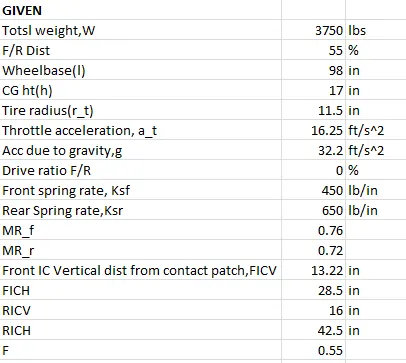
The tire is assumed to be infinitely rigid.
1. NO COMPENSATION:
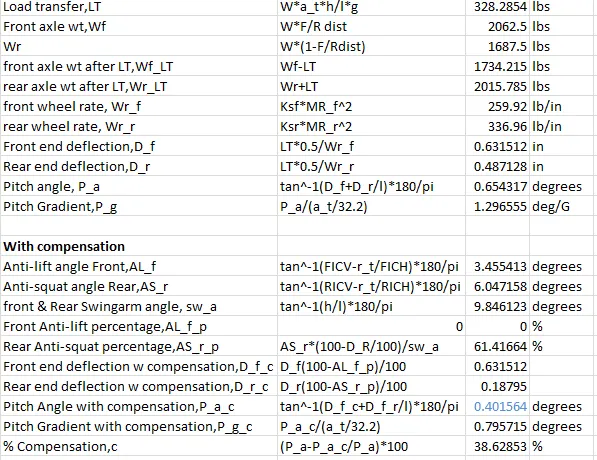
In order to calculate the pitching motion, we start by calculating the Load transfer in lbs, given by the formula tabluted below.
The vehicle is assumed to accelerate in this case and hence, the front axle loses weight while the rear axle gains the weight.
So the equation for both axles is as follows. The front axle weight after load transfer equals the difference between the static front axle weight and the load transfer weight while for the rear, it is the sum of the static rear axle weight and the load transfer weight.
The front and rear wheel rates are calculated respectively using the spring rates and Motion ratios for the front and rear axles.
The front and rear end deflections of the vehicle are mathematically calculated in inches using the load transfer weight and the front and rear wheel rates respectively. 0.5 is multiplied with the load transfer weight to account for each corner of the axles.
Finally the pitch angle is calculated using the front and rear deflections with the wheelbase and the vehicle is found to have a pitch angle of 0.6543 degrees and a pitch gradient of 1.29 deg/G( the throttle acceleration is divided by the acceleration due to gravity to get it in terms of G).
2. WITHOUT COMPENSATION:
WITH COMPENSATION:
To consider compensation, the anti-lift angle for the front axle and anti-squat angle of the rear axle is calculated using the above formula by incorporating the front and rear vertical and horizontal instantaneous center distances from the contact patch and tire radius respectively.
The swing arm angles are the same for the front and rear axles so it is calculated using the CG height and wheelbase and is obtained in degrees.
Since the front anti lift percentage is directly proportional to the drive ratio, it is 0%( the vehicle is rear wheel driven).
The rear anti squat percentage utilizes the above formula that contains the anti squat angle, drive ratio and swing arm angle.
The front and rear end deflections with compensation are calculated using the above formulae involving the deflections of the front and rear axles without compensation and the front anti lift percentage and rear anti squat percentage respectively.
The Pitch angle and gradient are calculated as before but this time, using the values incorporating compensation. The pitch angle was found to be 0.401 degrees.
3. To theoretically eliminate pitch, all other variables were left the same except the rear horizontal instantaneous center(RICH)( in order to satisfy the RICV=16 in condition). For the pitch angle to get close to zero, RICH had to equal 11in.
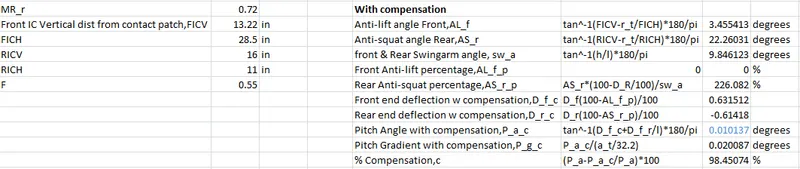
The compensation percentage shows that the pitching motion was almost completely eliminated(98.4%).
https://docs.google.com/spreadsheets/d/1ng2NLf9GhfC0ZttaKEV-_L613k46QQTC/edit#gid=1120843300