Basics of Electric Vehicle Simulations using Ansys
A short course which deals with the basics of electric vehicle simulations that can be performed using the software ANSYS. Note: The course is free for Indian Residents only.
- Content
- 11 hours
What you'll
be able to do.
10 modules,
built with industry.
01Basics of Electric Vehicle Simulations using Ansys
- Basics of Electric Vehicle SimulationsW01
- In the first video, we will explain the course curriculum and learning objectives in detail. We will explain what you will learn across the following modules.
- Why Electric Vehicles (EVs)?
- What are the components of an Electric Vehicle?
- How are EV components engineered?
- Need for simulations
- Simulation use cases
- In the first video, we will explain the course curriculum and learning objectives in detail. We will explain what you will learn across the following modules.
- Why Electric VehiclesW02
- In this video, we will focus on why there is a strong preference to Electric Vehicles as of 2020. We will take the logical approach of comparing key performance aspects of Electric Vehicles and Internal Combustion Engines-powered Vehicles.
- Comparing Internal Combustion Engine-powered Vehicles and Electric Vehicles from an emissions and performance stand-point
- To understand how the energy for propulsion originates
- Key emissions and how they are regulated
- In this video, we will focus on why there is a strong preference to Electric Vehicles as of 2020. We will take the logical approach of comparing key performance aspects of Electric Vehicles and Internal Combustion Engines-powered Vehicles.
- Vehicle ArchitectureW03
- In this video, we will focus on the functions of key components that are unique to electric vehicles.
- We will do this by taking you through the following concepts
- Differences in Vehicle Architecture between IC Engine Vehicles and Electric Vehicles
- Functions of the key components of an Electric Vehicle
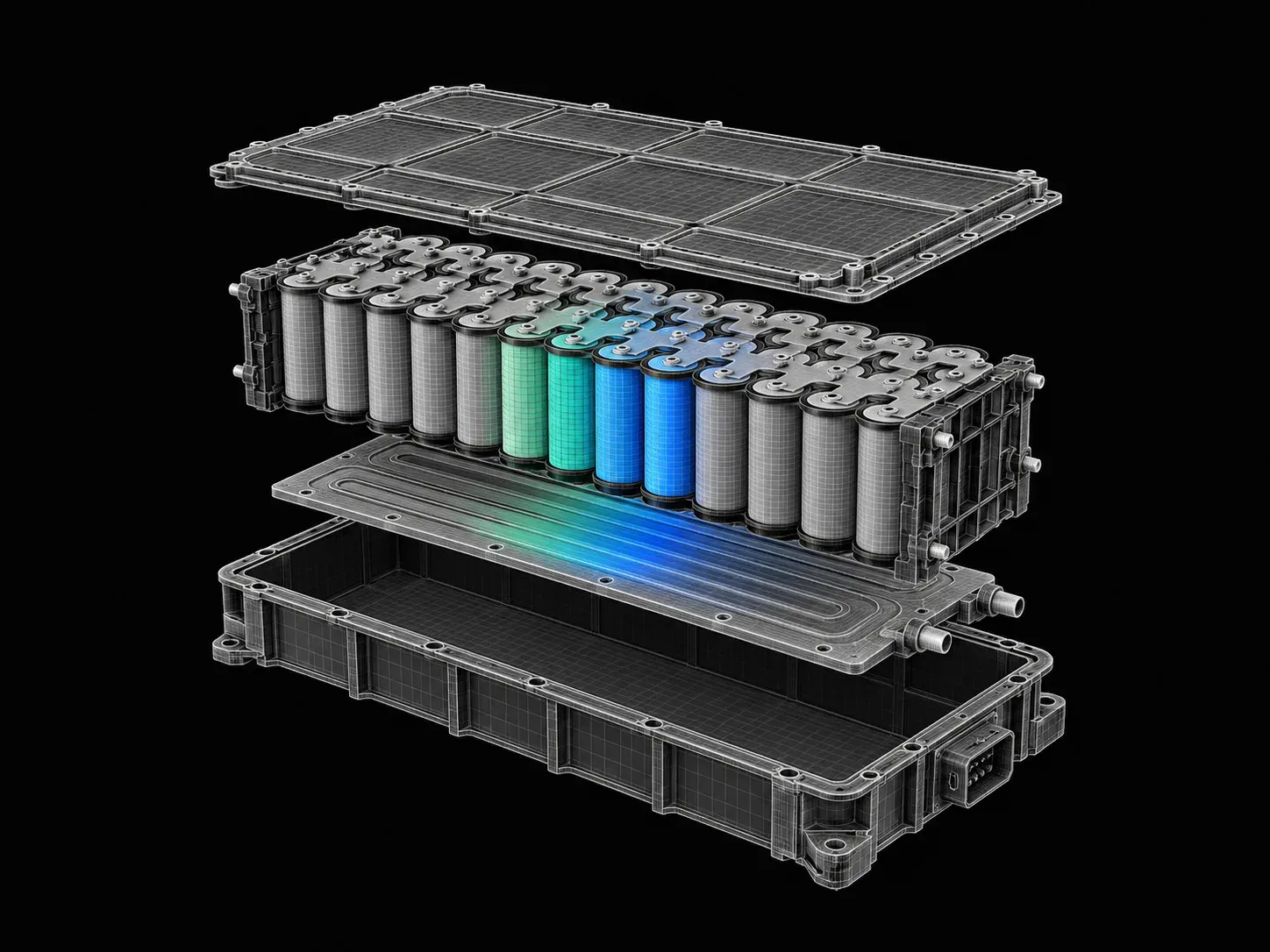
- Common Configuration of Battery Packs
- Fundamentals of Electrical Engineering
- Fundamentals of Batteries for EV ApplicationsW04
- In this video, we will focus on the fundamentals of Batteries.
- To be specific, the following concepts are covered
- How does a Battery work?
- Choosing Materials for Cathode and Anode
- Key Performance Criteria
- Temperature Sensitivity
- Source of Heat Generation in a Battery
- Approach to design a cooling system
- Heat Transfer Modelling for BatteriesW05
- In this video, we will focus on pen and paper calculations to estimate the temperature distribution inside a battery.
- Analytical Measurement of Temperature Distribution
- Energy Balance on a Control Volume
- Deriving a governing equation
- Analytical Solution
- GSheets Calculator
- Drawbacks of Analytical Method
- Solution to overcome the drawbacks
- In this video, we will focus on pen and paper calculations to estimate the temperature distribution inside a battery.
- Simulating a BTMSW06
- In this video, we will explain how a basic Battery Thermal Management System can be simulated using ANSYS Fluent. You will be learning the following
- How to setup a case using ANSYS Fluent
- BTMS problem definition
- Boundary Conditions
- Initial Conditions
- Setting up Material Properties
- Activating Key Physical Models
- Case Setup Walkthrough
- Results and Discussion
- In this video, we will explain how a basic Battery Thermal Management System can be simulated using ANSYS Fluent. You will be learning the following
- EV Motor Sizing and Motor Drive Analysis - IntroductionW07
- In this session ,you will learn
- Motor power estimation for on-road Electric Vehicle,
- Forces acting on vehicle – Rolling resistance & aerodynamic drag
- Acceleration and hill climbing
- Quick calculations in Excel
- Driving cycle
- Classification of electric motors
- Factors affecting the choice of an EV motor
- In this session ,you will learn
- Motor Power Estimation, Motor SizingW08
- In this session,you will learn
- Fundamentals of Brushed DC and BLDC motor operation and construction
- Fundamental equations for PMSM sizing
- Basics of power converter operation
- Analytical design of Permanent Magnet Synchronous Machine (PMSM) with Ansys RMxprt and Maxwell (2D)
- In this session,you will learn
- External AerodynamicsW09
- In this module, we discuss the basics of external Aerodynamics.
- We will touch upon the key concepts of fluid mechanics and then teach you the 2 most fundamental forces in Aerodynamics.
- We also delve into how to perform external flow simulation using Ansys Fluent.
- DC-DC ConverterW10
- An overview of EV power system
- Propulsion system and auxiliary system of an EV
- Basics of EV battery system and choice of system voltage
- Types of DC-DC converter for an EV application
- Ansys tools at various stages of design
- Template-based design of full bridge converter using Ansys PExprt
- Circuit simulation of power converter using Ansys Twin builder
- Magnetic analysis of high frequency transformer with Ansys PEmag
- Electrothermal analysis of PCB with Ansys SIwave
- Thermal considerations of PCB using Ansys Icepak
- Basics of Electric Vehicle SimulationsW01
Questions,
answered.
Who can take up the Electric Vehicles course?
Students and graduates of mechanical, automotive and electrical engineering can take up the Basics of Electric Vehicle Simulations using the Ansys course. If your area of interest lies in designing and analysing an Electric Vehicle, you can pursue this ANSYS online course.
Is this ANSYS course an online program?
Yes, the Basics of Electric Vehicle Simulations using Ansys is a 100% online course.
What is the duration of the Basics of Electric Vehicle Simulations using Ansys?
This Electric Vehicles online course is a 10-week course covering all the basic concepts of Motors, BTMS and DC-DC convertors used for an EV application.
What are the plans available for this Electric Vehicles course?
The basic plan would give you two months of access, the pro plan would give you four months of access, and the premium plan would provide you with lifetime access. You can choose a plan based on your requirements.
How much can a Simulation Engineer earn?
According to Glassdoor, the average salary of a Simulation Engineer is around ₹7 lakhs per annum. However, it primarily depends on your experience and expertise.
Is there any certificate for completing this Electric Vehicle course?
Yes, After completing the Basics of Electric Vehicle Simulations using the Ansys course, you shall be given a course completion certificate. The top 5% of the scorers will be given a merit certificate alongside the course completion certificate.
How can I clear my queries if got a doubt while pursuing this ANSYS online course?
You can clear your queries with email and forum support.
Who has designed this Electric Vehicle design course?
Industry experts in this domain have designed Basics of Electric Vehicle Simulations using the Ansys course to make this course industry-relevant.
Do I need to work on projects for completing this ANSYS online course?
Yes, You have to work on projects for completing the Basics of Electric Vehicle Simulations using Ansys.
Not sure it's
the right fit?
A counsellor will walk you through the syllabus, projects and fee options — and tell you honestly if another course suits you better.