Unleashing the Power of MongoDB: A Guide to NoSQL Database Management
This open-source document database can be used to build highly scalable internet applications. It enables the programmers to work with data at ease
 Anup KumarH S·20 Mar 2023·4 min read

Founded in 2007, this open-source document database can be used to build highly scalable internet applications. It enables the programmers to work with data at ease. Let us explore more about it and understand how to master this cutting-edge tool.
What is MongoDB?
Large amounts of data are stored as documents in MongoDB, a NoSQL (not simply SQL) database. By adding "documents," MongoDB replaces the "rows" of traditional and relational data structures. Due to this, MongoDB developers now have the freedom to deal with changing data models.
What is MySQL?
MySQL is a free, open-source relational database management system that stores data. It analyses queries to retrieve data from the database and leverages RDBMS to provide referential integrity between table rows.
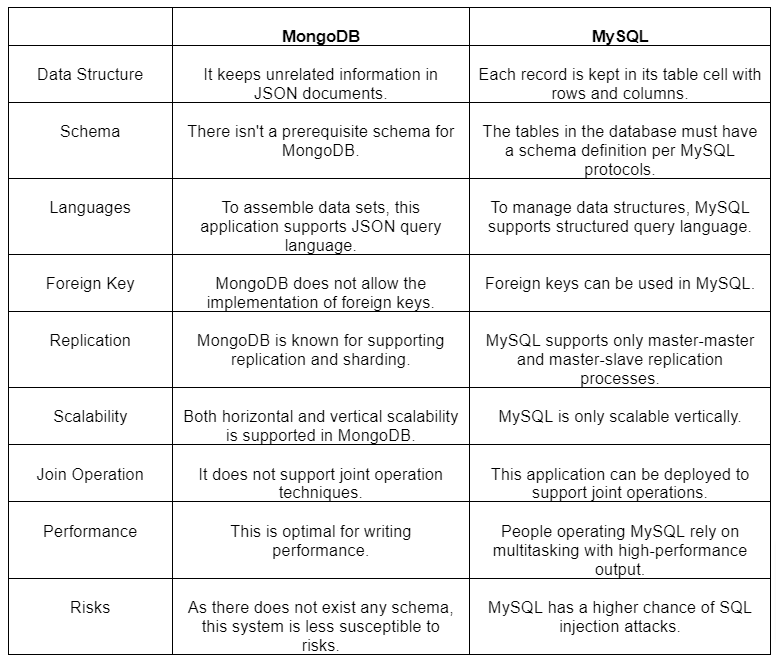
MongoDB vs MySQL – A Detailed Analysis
Let's examine some of the distinctions between these database management systems now that you know their goals.Who Should Enrol for MongoDB Tutorial Programs?
Anyone interested in learning about MongoDB, a cross-platform document-oriented database program, can apply for Skill-Lync’s Database course. This tutorial is designed for developers who want to learn how to work with MongoDB and MySQL and apply them to their projects. It is also suitable for those looking to understand the basics of working with MongoDB, such as creating databases and collections and querying data.

These are the fundamental aspects to search for in a premium course designed to teach MongoDB:
-
MongoDB fundamentals include data types, collections and commands
Some of the widely used MongoDB data types include string, Boolean, integer, object, date, array and null. While you will also become familiar with collections designated as GridFS files, chunks, indices and documents.
-
MongoDB shell, MongoDB Compass and the MongoDB Java driver
MongoDB Shell is an interactive JavaScript shell used to access and manipulate a database. It provides a powerful interface for managing MongoDB databases, collections, and documents. It can also be used to run database commands and perform administrative tasks.
On the other hand, MongoDB Compass is a graphical user interface for exploring and manipulating your data. It lets you quickly visualise and explore your schema to understand your data set's frequency, types, and ranges of fields.
Last, the MongoDB Java Driver library allows Java applications to access and interact with MongoDB databases. It provides an API that allows developers to write code to access and manipulate data stored in MongoDB databases.
-
Writing queries, aggregation pipelines, and indexing
Aggregation pipelines are a framework for data aggregation. They provide an efficient and powerful way to process data by combining multiple stages, allowing developers to perform data manipulation, filtering, and sorting operations on large datasets.
Indexing in MongoDB helps formulate data structures that improve the speed of information retrieval operations on a database. Indexes can be created on any field or sub-field of a document, allowing users to search for documents with specific attributes quickly.
To provide you with a glimpse of operational queries here we have listed a few MongoDB commands and mentioned their tasks:
- mongo -- launches the MongoDB shell
- show dbs -- display all databases
- use <database> -- switch to a database
- db -- check the current database
- show collections -- show the collections in the current database
- db.collection.find() -- query a collection
- db.collection.insert() -- insert a document into a collection
- collection.update() -- update a document in a collection
- db.collection.remove() -- remove a document from a collection
- db.collection.drop() -- drop a collection
Once you have mastered the aforesaid skills, it will be critical to learn the tactics that will help in:
- Scaling several MongoDB applications
- Developing advanced programs using MongoDB
- Improving performance and troubleshooting techniques
What Projects Will You Complete in Skill-Lync’s Database Course?
There will be two industry-level projects that you will need to complete to secure the course completion certificate. These are as follows:
Project 1: Designing an E-Commerce Database
As you have already understood for storing, organising, and retrieving information, databases are essential tools. These instruments are essential for developing an e-commerce system, as well. E-commerce is supported and managed by the system's interactions owing to a well-structured database. You will be creating such databases for this project.
Project 2: Scaling and Designing an E-Commerce Database
A platform's scalability is crucial when choosing an eCommerce solution. To keep up with demand, your e-commerce website has to be adaptable. The database of your e-commerce platform is one of the crucial elements that will significantly impact its capacity to scale. You will scale your e-commerce database as part of this project.
Conclusion
Both MongoDB and MySQL are popular technologies for accumulating, managing and representing data. MongoDB is a document-oriented database which allows for quick and easy storage of chunks of data. Whereas MySQL is an SQL-based relational database providing more structured data. Each of them has its advantages and disadvantages depending on their application.
In general, MongoDB is better suited for unstructured data and real-time applications, while MySQL is better for applications that require transactions and complex queries. To gather in-depth knowledge about these two database management systems enrol in Skill-Lync’s course.
Talk to our experts and get your free demo.


