Top 10 Free Online Engineering Courses (and Which Give a Certificate)
Ten free online courses that build real engineering skills, from NPTEL and MathWorks to Virtual Labs, MIT OpenCourseWare and Skill-Lync's free full courses: what each costs, which give a certificate, and how NPTEL's certificate score works.

The best free online engineering courses in 2026 are NPTEL's IIT and IISc courses, MathWorks' MATLAB and Simulink Onramps, Ansys Innovation Courses, the Ministry of Education's Virtual Labs, MIT OpenCourseWare, Cisco Networking Academy's starter courses and Skill-Lync's free full courses on YouTube. All are free to learn. Only some give a certificate, and NPTEL's needs a proctored exam with a fee.
Key takeaways (checked 19 Nov 2026)
- NPTEL shows 2,027 courses offered, runs two semesters a year (Jan-Jun and Jul-Dec), and says "course learning is free; the certification exam is optional" (nptel.ac.in).
- An NPTEL certificate needs two minimums: at least 10 of the 25 assignment marks and 30 of the 75 exam marks (NPTEL FAQ). A good exam does not rescue skipped assignments.
- MathWorks: "Onramp courses are free for everyone and do not require a subscription" (MathWorks training FAQ).
- Virtual Labs (Ministry of Education): over 175 labs with about 1,590 web-based experiments (vlab.co.in).
- Skill-Lync has 35 complete courses free on YouTube, 185 hours of video, grouped and linked at Grow by Skill-Lync (Skill-Lync catalogue, 19 Nov 2026).
This list is for B.Tech and diploma students and early-career engineers in India who want skills that show up in interviews, not just a certificate count. We are Skill-Lync, so three of the ten picks are ours; each is marked, and the other seven are the best free options we know of from universities, government and software makers.
The 10 free courses at a glance
| Course | Provider | Best for | Certificate |
|---|---|---|---|
| 1. NPTEL courses (any of 2,027) | IITs and IISc | Core subjects, GATE preparation | Yes, after a proctored exam (fee) |
| 2. MATLAB Onramp | MathWorks | Every branch | Course certificate in the course menu |
| 3. Simulink Onramp | MathWorks | EEE, controls, EV, mechatronics | Course certificate in the course menu |
| 4. Ansys Innovation Courses | Ansys (Synopsys) | FEA, CFD, physics behind simulation | Check the course page |
| 5. Virtual Labs | Ministry of Education | Lab experiments your college lacks | No |
| 6. MIT OpenCourseWare | MIT | Depth in one subject | No ("MIT does not offer credit or certification") |
| 7. Python Essentials 1 / Introduction to Cybersecurity | Cisco Networking Academy | CSE, ECE, IT, anyone starting to code | Check the course page |
| 8. CATIA V5 Full Course for Beginners | Skill-Lync (ours) | Mechanical and automotive design | Ask a counsellor; included in the paid course |
| 9. AutoCAD Essentials for Civil Engineers | Skill-Lync (ours) | Civil drafting | Ask a counsellor; included in the paid course |
| 10. Basics of Digital Electronics | Skill-Lync (ours) | ECE, embedded, VLSI basics | Ask a counsellor; included in the paid course |
1. NPTEL: which free online courses from the IITs are worth doing?
NPTEL is the most useful free option for Indian engineering students: courses taught by IIT and IISc faculty, covering standard B.Tech subjects, free to watch, with an optional proctored exam for a certificate. Its site shows 2,027 courses offered, in two semesters a year, January to June and July to December.
The next semester starts in January 2027. As of 19 Nov 2026 neither nptel.ac.in nor swayam.gov.in had posted the January 2027 course list or dates; SWAYAM's latest notice was about July 2026 exam registration, extended to 5 Nov 2026. Watch those two sites in December, because enrolment and exam registration have deadlines.
Pick NPTEL courses that match a subject you are weak in or a GATE paper you are taking, rather than collecting unrelated certificates. Our GATE 2027 study plan shows how to fit them around exam preparation.
How is the NPTEL certificate score calculated?
NPTEL takes 25% of the final mark from assignments and 75% from the proctored exam. You are certified only if your average assignment score is at least 40 out of 100 (10 of the 25) and your exam score is at least 40 out of 100 (30 of the 75). Passing one does not compensate for failing the other.
Three example learners on a 12-week course, worked out by a script kept with this article:
- Asha missed two weekly assignments (scored 0) and averaged 64.17%, giving 16.04 of 25. Her exam mark of 62 gives 46.5 of 75. Final 62.5: certified.
- Ravi skipped seven weeks and averaged 31.67%, giving 7.92 of 25. His exam mark of 70 gives 52.5 of 75. Final 60.4, higher than many passes, but no certificate: assignments are below 10 of 25.
- Meena averaged 95.83% on assignments (23.96 of 25) but scored 38 in the exam (28.5 of 75). Final 52.5, no certificate: the exam part is below 30 of 75.
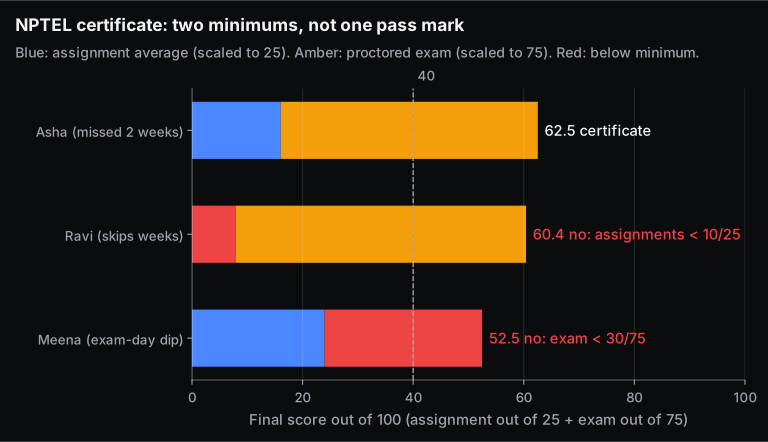
The lesson from Ravi is simple: submit every assignment, even the hard weeks. The NPTEL FAQ notes that some courses, including medical and certain programming courses, use different criteria, so read your course page once you enrol.
2. MATLAB Onramp: is it really free?
Yes. MathWorks' training FAQ says "Onramp courses are free for everyone and do not require a subscription to access." MATLAB Onramp is a self-paced, browser-based tutorial: commands, vectors and matrices, indexing, plots, data import, logical arrays, programming and a final project. You do not need a MATLAB licence to take it.
MATLAB comes up in interviews for controls, automotive, EV, signal processing and data roles, so this is the one course on the list that suits every branch. The course menu has a "Course certificate" option that records your completion percentage and can be shared on LinkedIn. For licence options after the Onramp, see Is MATLAB free for students?
3. Simulink Onramp: who should take it?
Electrical, electronics, mechatronics and automotive students who will model systems: motors, controllers, battery packs, vehicle dynamics. MathWorks names Simulink Onramp as its free starting point for Simulink. Take MATLAB Onramp first; Simulink models use MATLAB variables and plots, so the second course goes faster.
After both Onramps, a good free next step is Skill-Lync's Physical Modeling in Simscape, Simulink and MATLAB course on YouTube (5.5 hours).
4. Ansys Innovation Courses: free FEA and CFD theory with simulations
Ansys, now part of Synopsys, offers free Innovation Courses that pair physics theory with Ansys simulations and real-world case studies. In its words, these are "online lecture videos, led by Ansys experts and key academic partners", with homework, tutorials and quizzes. They suit mechanical, aerospace and civil students heading towards FEA or CFD roles.
Pair them with the free Ansys Student software, which has mesh limits worth knowing before you start a project; our guide Is Ansys free for students? explains the limits and how to stay within them.
5. Virtual Labs: can you do lab experiments online?
Yes, for many standard experiments. Virtual Labs is a Ministry of Education project under the National Mission on Education through ICT. Its site lists over 175 virtual labs with about 1,590 web-enabled experiments, built by a consortium of twelve participating institutes with IIT Delhi as coordinator. They are simulation-based and need no setup.
Use them when your college lab is short of equipment, or to repeat an experiment before a viva. They are not a replacement for handling real instruments, but they are good for understanding what the experiment should show.
6. MIT OpenCourseWare: the best free courses without a certificate
MIT OpenCourseWare is a free, open collection of material from more than 2,500 MIT courses: lecture notes, problem sets with solutions, exams and, for many courses, video lectures. There is no enrolment and no deadline. MIT is explicit that it "does not offer credit or certification to users of OCW."
Use it to go deep on one subject where your college course was thin, for example thermodynamics, dynamics or signals, and work the problem sets. Solving problems from a strong course builds more interview confidence than a stack of completion certificates.
7. Cisco Networking Academy: free Python and cybersecurity
Cisco's Networking Academy lists Python Essentials 1 ("No prior experience necessary") and Introduction to Cybersecurity as free online courses. They suit CSE, IT and ECE students, and mechanical or civil students who want a structured first programming course before learning Python for engineering.
Once you can write basic Python, apply it to engineering problems: Skill-Lync's free Python Fundamentals for Mechanical Engineers (3.5 hours on YouTube) uses mechanical examples.
8-10. Skill-Lync's free full courses on YouTube
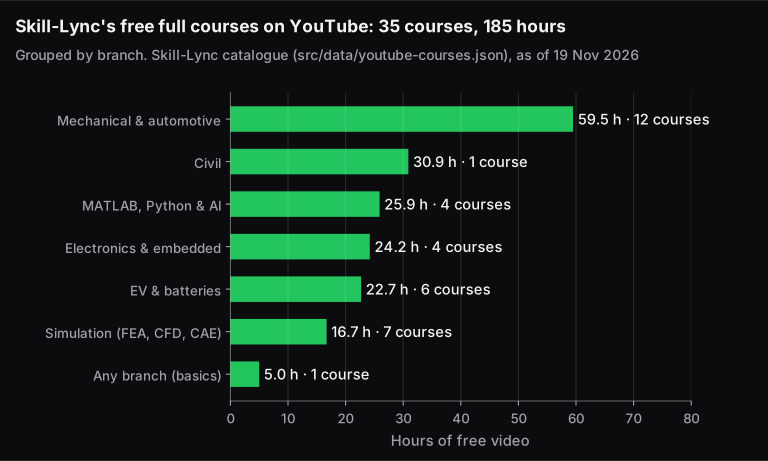
Skill-Lync has published 35 complete courses, workshops and webinars free on YouTube, totalling 185 hours, and lists them with chapter guides at Grow by Skill-Lync (Skill-Lync catalogue, 19 Nov 2026). Together they have about 59 lakh views. These three are the most complete for their branches:
- 8. CATIA V5 Full Course for Beginners: 5.2 hours in 22 chapters, about 7.1 lakh views. It moves from the sketcher to part design, drafting, assembly design and surface design, with an exercise in each part (a screw jack, a caster wheel).
- 9. AutoCAD Essentials for Civil Engineers: 30.9 hours in 60 chapters, the longest free course in the catalogue. It goes from 2D drafting, dimensioning and blocks to xrefs, plotting and 3D modelling, using a floor plan and a footing plan.
- 10. Basics of Digital Electronics: 20.4 hours in 58 chapters, the base for embedded systems and VLSI.
The YouTube courses are free with no sign-up. For a certificate, each course page has a form: leave your name and phone number and a Skill-Lync counsellor will call you about it. The paid Skill-Lync courses linked from each page include a certificate along with mentor-reviewed projects.
What else does Skill-Lync offer free?
Two more free resources, both on skill-lync.com:
- Grow by Skill-Lync: 470 free video lessons (217 hours) from 149 Skill-Lync courses, usually the first three lessons of each course, with transcripts. They let you try a paid course before deciding. The full catalogue is listed in our Grow guide.
- Interactive engineering books: 26 free books for core subjects from semester 3 onwards, such as strength of materials, thermodynamics and digital electronics. Each chapter has an interactive, and chapters are mapped to AU, VTU, SPPU, MU and KTU syllabi.
Which free course should you start with for your branch?
| Branch | Start with | Then |
|---|---|---|
| Mechanical / automotive | MATLAB Onramp | CATIA V5 full course, an NPTEL core subject, Ansys Innovation Courses |
| Civil | AutoCAD Essentials for Civil Engineers | An NPTEL structures or geotechnical course, Virtual Labs |
| Electrical | MATLAB Onramp, then Simulink Onramp | NPTEL power electronics or machines, Simscape full course |
| Electronics / ECE | Basics of Digital Electronics | NPTEL embedded or VLSI course, Cisco Python Essentials 1 |
| CSE / IT | Cisco Python Essentials 1 | MIT OCW algorithms, an NPTEL data or ML course |
Do free certificates help you get a job?
On their own, rarely. A certificate shows you finished something; an interviewer will still ask you to explain the work. What helps is being able to show it: a CATIA assembly you modelled, a Simulink model that runs, an NPTEL course in a core subject with a strong score, a small project on GitHub. Choose two or three courses that build towards one project, not ten unrelated ones.
Free courses also have limits. They rarely include feedback on your work, and few cover industry tools in depth. When you are ready for mentor-reviewed projects in a specific field, Skill-Lync's paid courses, such as Basics of CATIA V5 and AutoCAD Essentials for Civil Engineers, build on the free versions above. Not sure which fits your branch? Talk to a Skill-Lync counsellor.
Frequently asked questions
Are NPTEL courses free?
Yes, learning is free. NPTEL says course learning is free and the certification exam is optional. You can watch the videos and do the assignments without paying. A certificate needs the proctored exam, which has a nominal fee, and you must reach at least 10 of 25 in assignments and 30 of 75 in the exam.
Which free online course is best for mechanical engineers?
Start with MathWorks' free MATLAB Onramp, because MATLAB appears in most mechanical and automotive roles. Then pick one CAD course, such as Skill-Lync's free CATIA V5 full course on YouTube, and one NPTEL course in a core subject you find hard. Ansys Innovation Courses suit students heading towards FEA or CFD.
Which free online courses give a certificate?
NPTEL gives a certificate after a proctored exam with a fee. MathWorks' Onramps have a shareable course certificate showing completion. MIT OpenCourseWare and Virtual Labs give none. For Skill-Lync's free YouTube courses, a counsellor can tell you about certificates; Skill-Lync's paid courses include one with mentor-reviewed projects.
When does the NPTEL January 2027 semester start?
NPTEL runs a January to June semester every year, so the next one starts in January 2027. As of 19 Nov 2026 the course list and dates were not yet posted on nptel.ac.in or swayam.gov.in. Check both sites in December, because enrolment and exam registration close on fixed dates.
Are Skill-Lync courses free?
Partly. Skill-Lync has 35 complete courses free on YouTube (185 hours), 470 free lessons from 149 paid courses on Grow, and 26 free interactive books. The full paid courses add the remaining lessons, mentor-reviewed projects and a certificate. A counsellor can help you pick one.
Sources and further reading
- NPTEL, home page (2,027 courses offered; free learning, optional exam), Semester information (two semesters a year; 25% assignments, 75% exam) and FAQ (certificate criteria), accessed 19 Nov 2026.
- SWAYAM, home page (July 2026 semester notices; exam registration extended to 5 Nov 2026), accessed 19 Nov 2026.
- MathWorks, Online Training Courses FAQ and MATLAB Onramp, accessed 19 Nov 2026.
- Ansys (Synopsys), Academic learning resources: Ansys Innovation Courses, accessed 19 Nov 2026.
- Virtual Labs, Ministry of Education, About us, accessed 19 Nov 2026.
- MIT OpenCourseWare, About OCW, accessed 19 Nov 2026.
- Cisco Networking Academy, Python Essentials 1 and Introduction to Cybersecurity, accessed 19 Nov 2026.
- Skill-Lync, Grow by Skill-Lync (free lessons and the 35 free YouTube courses), interactive books, and the script that computed the NPTEL examples and YouTube totals for this article (19 Nov 2026).